

Biogas and biomethane: France’s outlook once again very favorable
Methanisation, biogas, biomethane, green gas, renewable gas, natural gas for vehicles (NGV), bioGNV: what are we talking about?
What is methanization?
Methanization is a process based on the decomposition of putrescible (rotting) matter by bacteria in the absence of air. This is called fermentation or anaerobic digestion (in the absence of oxygen). Methanization is a phenomenon that occurs naturally, for example in marshes, where gas is emitted. But it can also be reproduced industrially in methanization units (or methanizers) by letting organic matter ferment for several weeks in an oxygen-free digester.
The anaerobic digestion process generates two elements:
- biogas, composed mainly of methane (50% to 70%), carbon dioxide, hydrogen sulfide and, in smaller quantities, water
- a by-product called digestate, which can be used as fertilizer for agricultural soils
This biogas can be transformed into heat, used to generate electricity (or both in a combined heat and power unit).
The biogas can then be purified. During this process, carbon dioxide (decarbonation), hydrogen sulfide (desulfurization) and water (dehydration) are removed. It then becomes biomethane, with the same characteristics as natural gas. Biomethane can then be injected into the gas network. It can also be used as a fuel for vehicles. The term
Biogas and biomethane are both renewable gases (also known as green gases) produced from waste.
A key issue: input sources
There are a large number of input sources for anaerobic digestion plants:
- agricultural waste (manure, slurry, etc.)
- household and community waste (household bio-waste, green waste, etc.)
- municipal waste (biowaste from catering, supermarkets, etc.)
- food industry waste (material loss in the process)
- industrial waste (industrial sludge, production scrap, etc.)
- sewage sludge (from wastewater treatment plants)
However, these inputs have very different methanogenic capacities (i.e. the quantity of methane released per tonne at the outlet of the anaerobic digester).
Indeed, the methanogenic potential varies greatly according to the product and its level of putrescibility. One of the only exceptions is wood waste, where anaerobic micro-organisms are unable to degrade lignin.
In the food industry, methanogenic power is just as disparate.
Example: One tonne of oat straw produces three times more methane biogas than one tonne of energy corn. In this way, oat chaff has found a new use of choice, after its use as bedding, fuel bricks and livestock feed.
Wastewater treatment plants: a financial opportunity to be seized
Sewage sludge from wastewater treatment processes is organic waste with a high methanogenic potential. Methanization therefore produces methane-rich biogas. What’s more, anaerobic digestion can reduce remaining sludge volumes by 20% to 50%, thereby cutting management costs.
In addition, adding value to the gas produced can provide additional income for the plant, thanks to various public support mechanisms.
The AGEC law (anti-waste law for a circular economy) should boost the volume of inputs. Already imposed on the largest producers, source separation and recovery of bio-waste will be generalized to all by January 1, 2024, obliging professionals and local authorities to organize appropriate collection circuits.
Biomethane and biogas development: a European priority
The European Union has made the development of biomethane production one of its priorities. There are three main reasons for this:
- as a replacement for natural gas, biomethane contributes to Europe’s decarbonization strategy, with a view to achieving carbon neutrality by 2050
- reducing Europe’s dependence on imported fossil fuels, particularly gas from Russia
- the positive impact in terms of local growth and employment
It should be emphasized that priority is now given to biomethane, not just biogas. Europe currently produces around 3.5 billion m3 of biomethane and some 17 billion m3 of biogas. If we are to meet Europe’s targets by 2030, we need both sustained growth in biomethane and the conversion of existing biogas production units into biomethane production units.
According to the European Biogas Association (EBA), there were 1,322 biomethane production facilities in Europe in April 2023 (1,222 at the end of 2022), a large proportion of them in France.
35 billion m³
of biomethane produced in Europe by 2030
Source: European Commission
France is one of Europe’s leaders
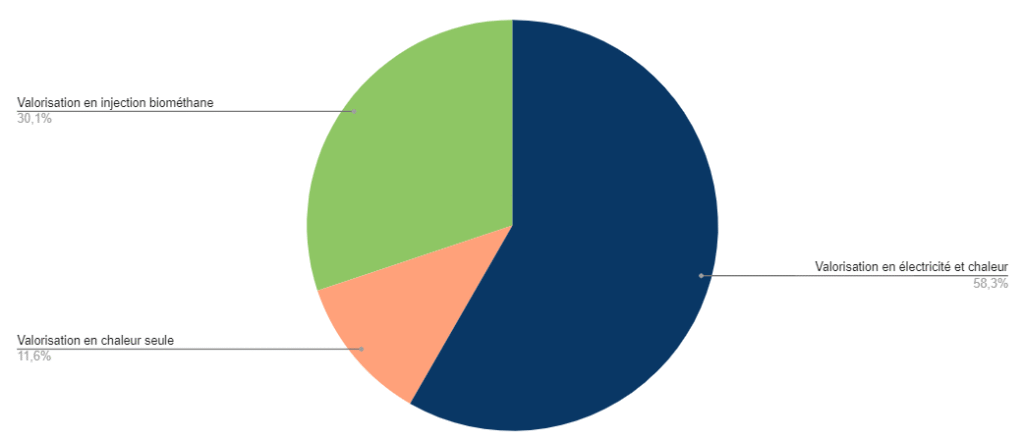
According to data compiled by MéthaFrance, France had 1,705 facilities producing and valorizing renewable gases in 2022.
Characteristics of renewable gas production and recovery facilities in France by the end of 2022 (in number of units)*.
Source: MéthaFrance
The majority of facilities (58%) produce electricity and heat by cogeneration from biogas. They include biogas plants, wastewater treatment plants and non-hazardous waste storage facilities. The number of these facilities rose by 5% in 2022 to 994 units. Biogas power generation represented 576 MW of installed electrical capacity at the end of 2022.
Also in 2022, biomethane production for injection represented 30% of total installations. At the end of 2022, France had 514 units, almost twice as many as in 2020 (213 units). These are mainly agricultural units (441 units), far ahead of wastewater treatment plants (35 units).
This sector is enjoying very strong growth (+41% by 2022), with 149 units commissioned by 2022. France alone accounts for over 40% of Europe’s biomethane production units. France is forecasting biomethane production of 7 TWh in 2022.
By the end of 2022, there were almost 900 projects in the pipeline, which should enable the industry to continue to grow, subject to effective support from the public authorities.
Public support mechanisms available for your project
The biogas industry has enjoyed strong growth, but is currently experiencing a downturn. In view of the sector’s dynamism, the public authorities have decided to lower the feed-in tariff for biomethane in November 2020, with an average reduction of around 10%. A quarterly degressivity was also introduced on the same date. The public authorities wanted to avoid a bubble that could have cost the state dearly.
At the same time, like many industrial sites, anaerobic digestion plants have seen their costs soar as a result of inflation, the rising cost of certain raw materials and, above all, the rising price of electricity. Against this backdrop, many projects encountered difficulties in securing financing, resulting in a sharp increase in the number of projects in the waiting queue.
In response, the public authorities published a new tariff decree in June 2023, raising the biomethane feed-in tariff by more than 10% or even 15% (depending on site size). This tariff will also be indexed to changes in energy prices. At the same time, the Commission de Régulation de l’Energie (French Energy Regulatory Commission) is organizing calls for tender, notably the one launched in 2022, with three tranches: 500 GWh/year in December 2022, 550 GWh/year in June 2023, and 550 GWh/year again in December 2023. For each tranche, a quota of 200 GWh/year is reserved for projects producing less than 50 GWh/year. Winners will benefit from a 15-year feed-in tariff. This should give the industry some breathing space and visibility.
What are the prospects for renewable gas in France?
The current Multiannual Energy Plan (PPE) sets a biogas development target of 14 TWh/year, including 6 TWh/year of biomethane injected into the grid by 2023. In 2022, 9 TWh of biomethane were injected into the grid. The targets for 2023 will therefore already be well exceeded. For 2028, the PPE targets are 24 to 32 TWh of biogas, including 14 to 22 TWh of biomethane injected into the grid.
According to the French Ministry of Energy Transition, at the end of December 2022, 876 biomethane injection projects were in the queue, representing a production capacity of 15.8 TWh/year. The commissioning of projects currently in the queue would therefore already enable us to exceed our targets for 2028.
However, a new PPE – eagerly awaited by all stakeholders – is currently in preparation. It should significantly raise the development targets for biogas and biomethane in France. As soon as it is published, we’ll keep you informed of the development targets for renewable energies in France in a future article.
In the meantime, don’t hesitate to contact us to discuss the best opportunities for your project.