


What is CCUS?
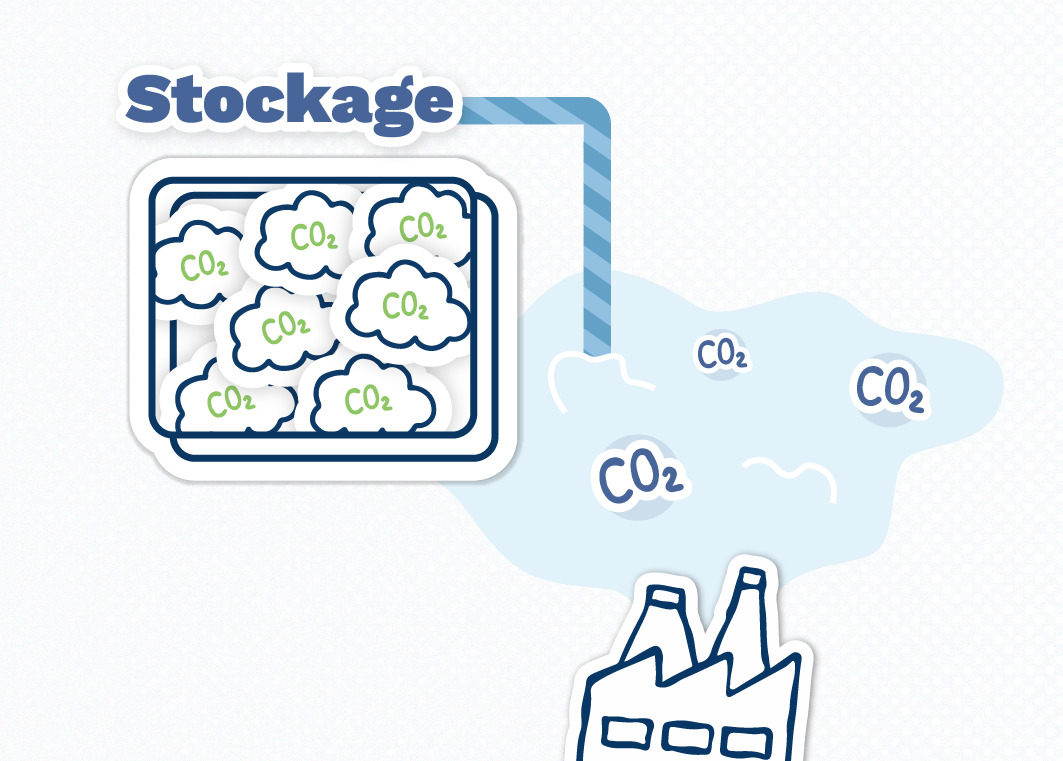
CCUS stands for Carbon Capture, Utilisation and Storage. It refers to a series of technological solutions for :
- captureCO2, mainly from emitting industrial sites, concentrate it, and then
- or store it, for example in fossil fuel deposits that have been fully explored and produced
- or use it, when a CO2 recovery operation is possible, as an input to manufacture products (e-fuels produced from hydrogen and CO2, production of plastics, concrete, etc.).
I want to decarbonize my industry
Strictly speaking, we should even be talking about CCTUS (Carbon Capture, Transport, Utilisation and Storage). As storage – or utilization – sites are often far (or even very far) from emission zones, the question of transporting CO2 by pipeline or ship is at the heart of the process.
Finally, the term ” CCS ” (Carbon Capture and Storage) is more commonly used when no use or recovery pathway has been identified. In this case, the captured carbon is stored.
Strictly speaking, we should even be talking about CCTUS (Carbon Capture, Transport, Utilisation and Storage). As storage – or utilization – sites are often far (or even very far) from emission zones, the question of transporting CO2 by pipeline or ship is at the heart of the process.
Finally, the term ” CCS ” (Carbon Capture and Storage) is more commonly used when no use or recovery pathway has been identified. In this case, the captured carbon is stored.
-10%
The reduction in greenhouse gas emissions made possible by the CCUS by 2050 at global level
Source: IEA
Importantly, CCUS is not intended to replace efforts to reduce greenhouse gas emissions. This position has been clearly stated by the French authorities, who believe that “CCUS is not a technology for maintaining ‘business as usual’: it should only be used for incompressible residual emissions, in the absence of other economically accessible solutions “ ¹.
¹ “CCUS Strategy”, a document to be submitted to industry for consultation in June 2023
At least initially, CCUS is therefore targeting activities for which there are no decarbonization alternatives in the medium term. These are industrial activities such as cement production, chemicals, metallurgy and so on.
The French strategy is now known
-5 à -10%
France’s industrial emissions reduction potential in 2030 thanks to CCUS
Source: French Ministry of the Economy, Finance and Industrial and Digital Sovereignty
In July 2024, the French Ministry of the Economy, Finance and Industrial and Digital Sovereignty published a status report and outlook for CCUS deployment in France. This document sets out France’s strategy and ambitions in this area.
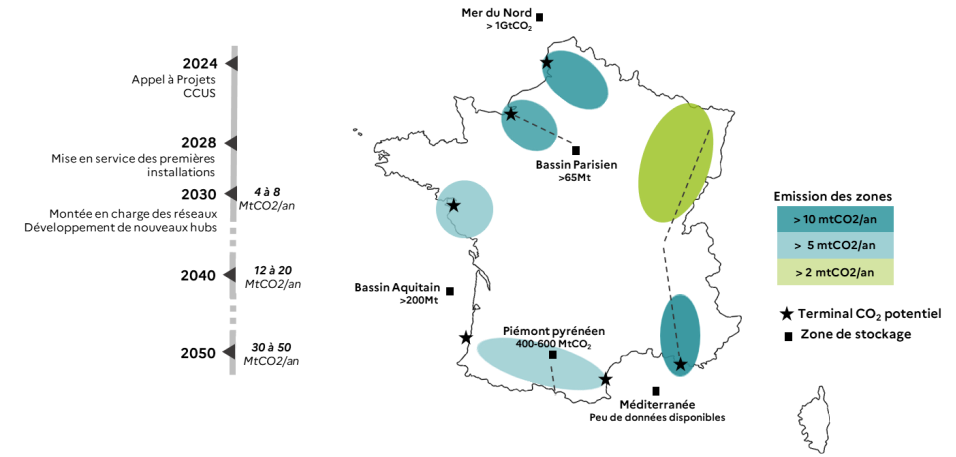
The French CCUS strategy is based on three distinct deployment phases:
- 2025-2030: first deployments leading to the development of two to four CCUS hubs (each capturing 1.5 to 4 MtCO2/year) in the industrial zones of Dunkirk, Fos-sur-Mer, Le Havre, Saint-Nazaire or on the Rhone axis.
🡺 target: 4 to 8 MtCO2/year captured
- 2030-2040: development of underground storage facilities and CCS networks, enabling capture to be extended to other geographical areas (Paris Basin, Mediterranean or Pyrenean Piedmont) and other sectors of activity (e.g. waste incineration).
🡺 target: 12 to 20 MtCO2/year captured
- 2040-2050: development of a network of CO2 infrastructures on a national and European scale to capture all residual emissions from the highest-emitting industrial sites and achieve carbon neutrality by the end of the period.
🡺 target: 30 to 50 MtCO2/year captured
Detailed trajectory ofCO2 capturein France
To achieve these objectives, the public authorities are already focusing on a number of measures:
- support for R&D, notably via the €35 million “Supporting innovation to develop new, largely carbon-free industrial processes” (SPLEEN) program.
- support for studies in Low-Carbon Industrial Zones (ZIBaC) from the France 2030 call for projects, to facilitate final investment decisions.
- the European Innovation Fund, which supports 26 European CCUS projects, including 3 in France.
CCUS: What’s the current state of play?
These initial support schemes led to the emergence of several CCUS projects in France.
Map of CUS projects in France
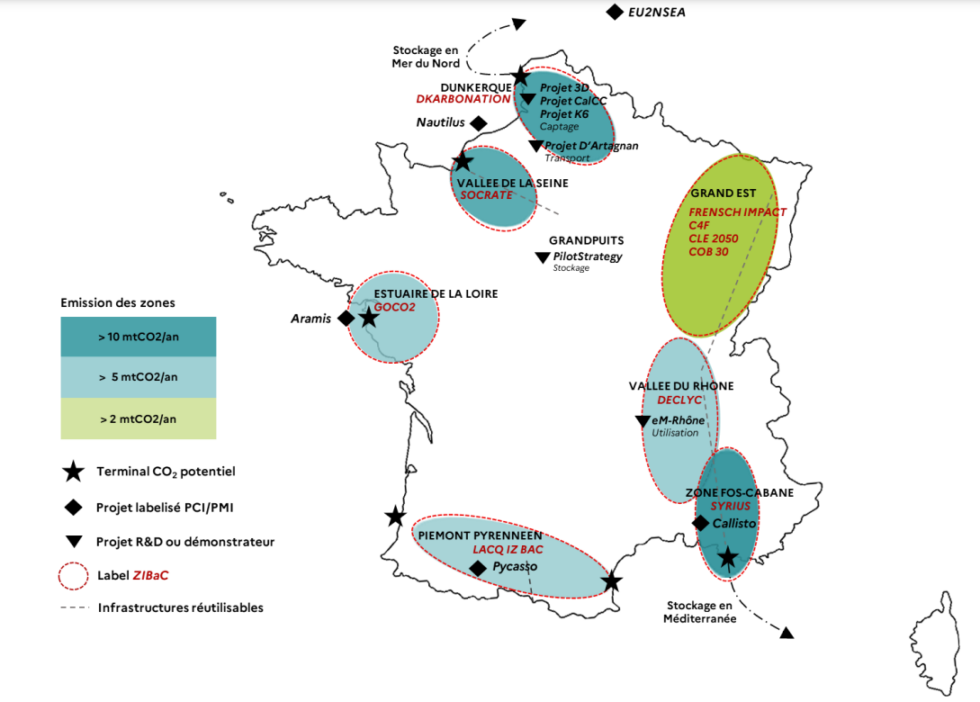
Examples include the K6 program to capture emissions from the Equiom cement plant (800,000 tonnes of cement produced per year) and the CalCC project of lime producer Lhoist (700,000 tonnes of lime produced/year), both located in the Dunkirk area. Ultimately, these two projects could capture 1.5 MtO2/year.
In terms of CO2 transport, the D’Artagnan project led by Air Liquide and the Dunkerque LNG liquefied natural gas import terminal plans to develop the infrastructure needed to transport and export 1.5 MtCO2/year by 2027, rising to 4 MtCO2/year in the medium term. After liquefaction, the carbon will be loaded onto ships for storage in the North Sea.
With this in mind, in January 2024 France signed a strategic partnership with Norway (the most advanced European country in terms of CCUS) to sequester 1.5 MtCO2/year by 2025 and up to 5 MtCO2/year by 2026 in storage sites in the Norwegian North Sea.
How much does it cost to storeCO2?
Given the still limited maturity of certain technological solutions, it is difficult to put a precise figure on the cost of CCUS. For example, the Northern Lights project in Norway, one of the most advanced in Europe, with a target capture rate of 1.5 MtCO2/year, would cost in excess of €200/tonne CO2.
For the deployment of the first major projects, the French government is planning to provide direct subsidies over a 15-year period. These will cover the difference between the cost of the CCUS and the avoided cost of CO2 on the EU-ETS CO2 trading scheme, to which industrial emitters are subject. This is known as a carbon contract for differences. By way of comparison, the price of CO2 on the EU-ETS averaged €67/tonne in the first half of 2024.
Thus, any increase in the price of CO2 in the future would reduce the amount of direct subsidy granted to the CCUS project.
Dametis EMS software helps you reduce your industry’s carbon emissions