


Decarbonization: Definition and Challenges in Industry
We are facing a climate emergency, and to counter this situation, decarbonization has become an imperative for organizations. Everyone is talking about decarbonization, but what really lies behind this term that has become so popular?
Decarbonization: Definition of a trending topic
Decarbonization encompasses all actions implemented with a view to reducing carbon dioxide emissions. This term applies at various scales, whether at the level of a country, its inhabitants, or a company such as an industrial facility.
Faced with today’s significant pollution, some countries have had no choice but to implement action plans aimed at boosting decarbonization within their territories. In France, the State is investing more than 5 billion euros in this direction in the hope of achieving carbon neutrality by 2050.
Although greenhouse gas emissions are trending downward in France, the 2050 objective remains ambitious. This is because carbon neutrality means that we must not emit more GHG than our carbon sinks can absorb.
20%
only of GHG emissions produced in France are captured by natural carbon sinks.
Source: ADEME
To achieve this goal, everyone must redouble their efforts.
While some levers are easily actionable at an individual scale, corporate activities represent a significant share of greenhouse gas emissions. Depending on the stakeholders, these emissions vary greatly and their reduction can prove complex.
According to 2023 data from the SDES*, four sectors of activity must still redouble their efforts to decarbonize their operations.
Among these sectors, the following are notably concerned:
(*Public statistics for energy, transport, housing, and the environment)
Dametis has always worked to support industrial players in their energy and environmental transition. A closer look at the subject of decarbonization in industry.
The Challenges of Decarbonization in Industry
To effectively combat global warming, industrial players have an important role to play. The challenges of decarbonization in this field are not only climatic; they are also regulatory, economic, and societal.
Among all the sectors that must decarbonize, the industrial sector is particularly affected by numerous regulations. These include:
The “Fit for 55” legislative package
This set of laws aims to phase out free emission allowances
The Greenhouse Gas Emissions Audit – BEGES
Certain industrial players, including those based in France employing more than 500 people, are now required to conduct a carbon audit every 4 years.
The DDADUE Law
Focused on energy efficiency, this law requires companies or groups with an annual consumption of 2.7 GWh or more to carry out an industrial energy audit. Please note that if this consumption exceeds 23.6 GWh, the obligation then shifts to the implementation of an ISO 50001 energy management system. Although this law does not directly concern GHG emissions, the subject is intrinsically linked and must be understood by industrial players.
Beyond regulation, the challenges surrounding decarbonization in industry are also financial. Indeed, since 2005, the European Union has adopted an Emissions Trading System (EU ETS). In 2023, a reform took place aimed at phasing out free emission allowances and reducing the number of allowances put into circulation each year. Consequently, the highest-emitting factories face certain price volatility, which can drastically impact their annual budgets.
It should also be noted that the SFDR (Sustainable Finance Disclosure Regulation) and the Green Taxonomy facilitate the financing of projects led by organizations designing or working on sustainable projects that benefit the environment. Consequently, financial institutions are more hesitant to finance projects for companies with an excessively high carbon footprint.
Finally, society is now aware of the climate urgency. End customers and suppliers now expect companies to undertake environmentally friendly actions. Decarbonizing your industry therefore also means ensuring you remain competitive against the many rivals present in the market.
How to Decarbonize My Industry?
Increasing competitiveness and reducing costs while complying with market regulations requires effort. Industrial players no longer have a choice; they must implement a decarbonization strategy.
But how can an effective strategy be put in place?
You cannot reduce your carbon emissions without having an idea of their initial quantity.

Step 1: The carbon audit or GHG assessment
While a carbon audit takes into account all of the company’s emissions (Scopes 1, 2, 3), a GHG assessment requires accounting for Scope 1 and 2 emissions (Scope 3 being optional), making it more accessible.
Beyond evaluating the quantity of GHG emissions, these audits highlight the areas where it is possible to be more efficient in reducing carbon impact.
Do you want to reduce your emissions in Scopes 1 and 2?
Dametis supports you!
Step 2: Implement monitoring software
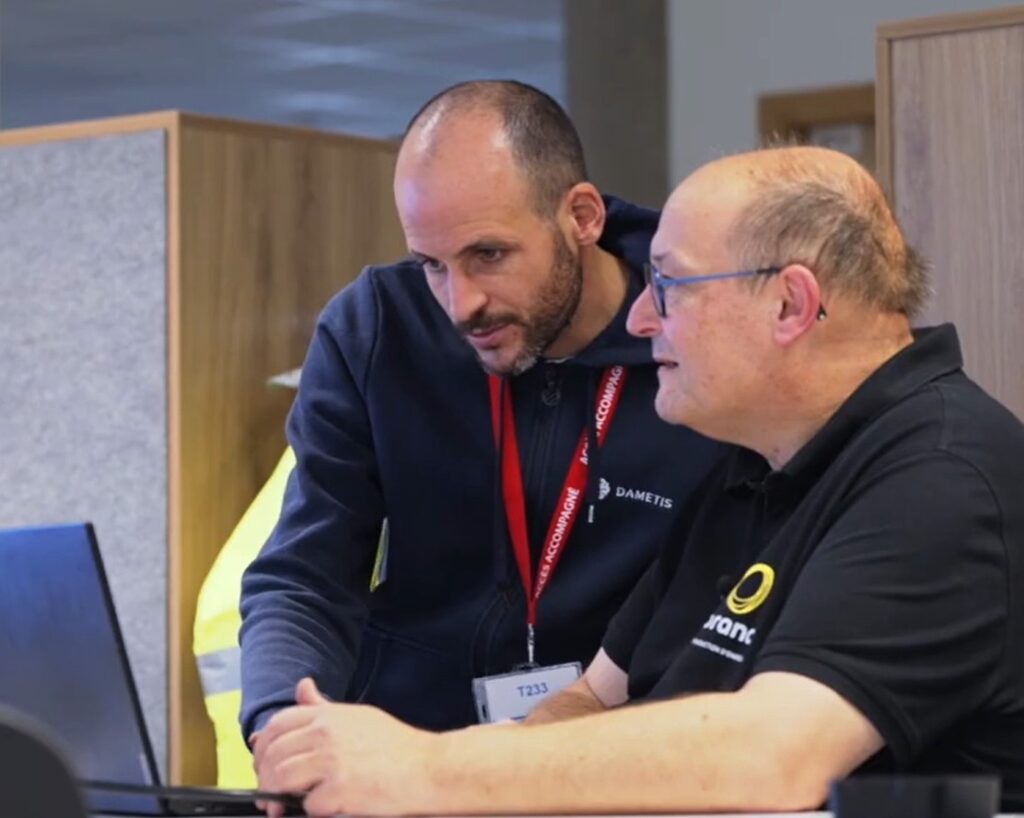
This step is optional; however, it greatly facilitates data collection and analysis. Our EMS software, MyDametis, detects your deviations in real time, allowing you to set objectives and deploy a site or multi-site roadmap for energy and water. Managing and monitoring your decarbonization strategy then becomes simpler for all professions involved in the matter.
+100 TCO2
The average quantity of CO2 identified and avoided each year at our clients’ sites within the first 6 months
Step 3: Reduce energy consumption through simple actions
The software significantly simplifies this third action by identifying “quick wins”: actions contributing to decarbonization that can be implemented immediately and require no specific investment.
- Is a furnace running empty?
- Is there a leak in the network?
- Are compressed air setpoints too high?
- Is equipment started several hours before use?
All these actions consume a significant amount of energy, yet industrial players are not always aware of it. The more visibility there is on data, the easier it is to identify quick wins and implement simple optimizations that impact the carbon footprint.
Step 4: Deploy other energy efficiency actions
If the energy optimization actions mentioned above are not enough to reach your decarbonization goals, or if you wish to further reduce your GHG emissions, investments can be made within your factory.
Firstly, over time, equipment wears out and sometimes becomes very energy-intensive. Replacing it can therefore help reduce GHG emissions.
Beyond replacing obsolete equipment, other improvement actions are possible:
- Process electrification. The idea here is to replace the combustion of fossil fuels with decarbonized electricity. Processes can be more easily electrified, particularly furnaces and all processes requiring hot water and/or steam.
- The implementation of waste heat recovery. In France, ADEME estimates that 36% of fuel consumption is lost to the atmosphere. Recovering waste heat constitutes a key lever for industrial decarbonization. Financial aid is available; find out more!
- The optimization of industrial refrigeration. The refrigeration cycle can be optimized, notably with self-adaptive electronic expansion valves or the regulation of distribution pumps, for example. By improving pump control based on needs, an average of 50% of their consumption is saved.
- The installation of an anaerobic digestion module, in parallel with the wastewater treatment plant (STEP). This module allows for the internal production of biogas. In addition to reducing costs, anaerobic digestion also represents a clear benefit for the environment.
Did you know?
Internally produced biogas emits ten times less CO2 than imported natural gas.
In summary…
Industrial decarbonization is now essential both for the environment and for the industrial players who commit to it, as it provides them with numerous significant advantages, notably the reduction of their energy bills.
There are many solutions and it is sometimes difficult to find one’s way, which is why Dametis supports you in your decarbonization strategy.
Contact us
to decarbonize your industry!
Error: Contact form not found.