

Fit for 55: what is it?
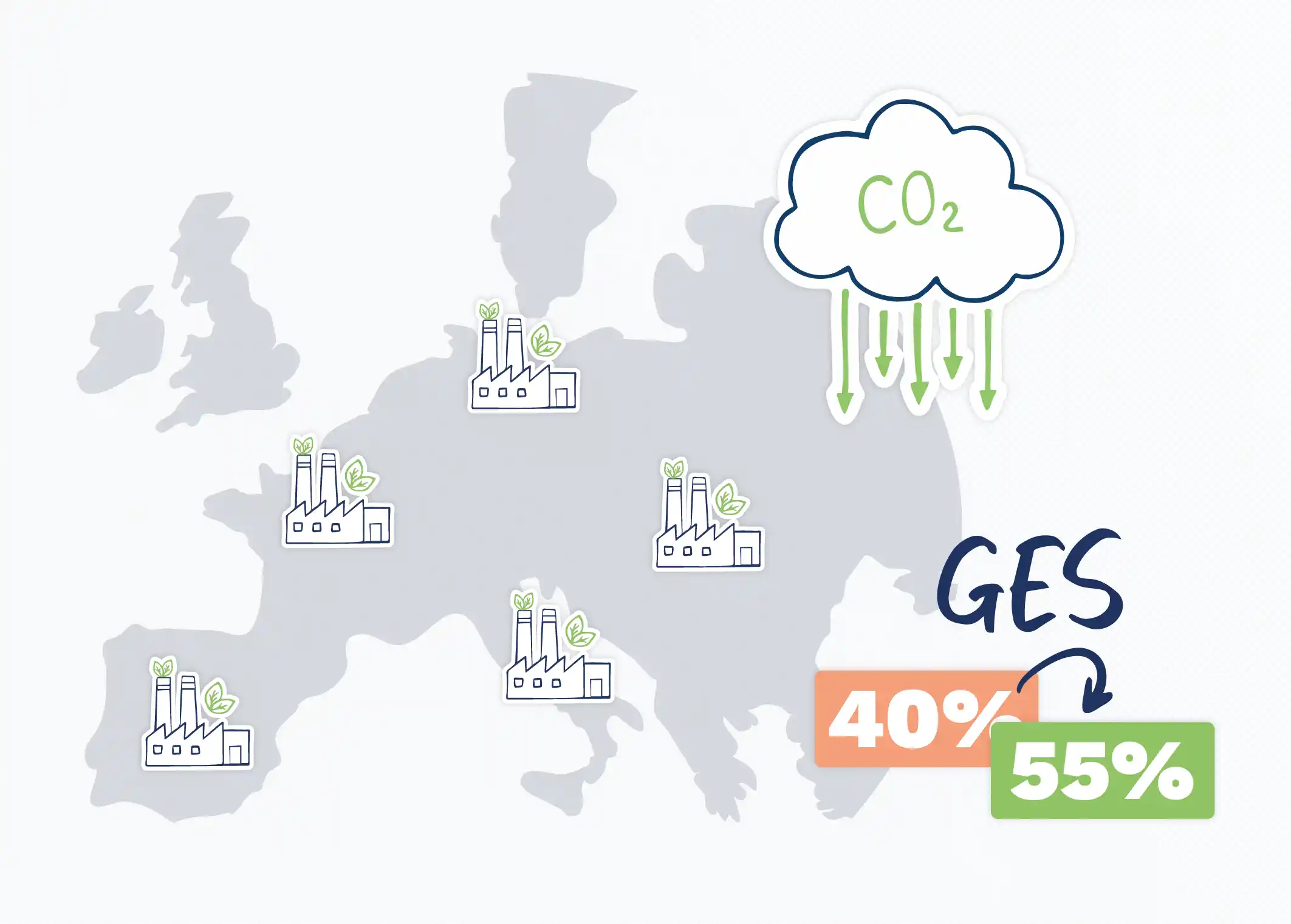
Fit for 55″ is a wide-ranging package of European legislation. Its name derives from its flagship measure: to reduce the European Union’s greenhouse gas emissions by at least 55% by 2030 (compared with the reference year 1990). This legislative package marks a clear strengthening of Europe’s greenhouse gas reduction ambitions, since the previous target was “only” a 40% reduction in European emissions by 2030 (still compared with 1990).
This legislative package aims to align all European legislation with this reduction target. And that’s its strength: it covers a very wide range of areas. Here’s an overview of the main measures.
Strengthening the European emissions trading scheme
The European Union Emissions Trading Scheme ( EU-ETS) is a pillar of European decarbonization policies.
The Fit for 55 initiative is gaining in importance with several key measures:
- A more rapid reduction of emission allowances in the system, from -2.2%/year to -4.3%/year over the period 2024-2027, then -4.4%/year in 2028-2030. All other things being equal, this measure will tend to push up the price per tonne ofCO2.
- Theinclusion of maritime transport on 40% of the sector’s verified emissions from 2024, 70% from 2025 and 100% from 2026.
- Implementation of the global carbon offset and reduction scheme for international aviation, known as CORSIA (Carbon Offsetting and Reduction Scheme for International Aviation).
- The phasing out of free quotas allocated to certain industrial sectors between 2026 and 2034 …
- … coupled with the effective implementation in 2026 of a border carbon adjustment mechanism (MACF) to preserve the competitiveness of the European industries concerned.
For more details on these measures, please read our article “EU-ETS reform: a challenge for European industries”.
The creation of a second emissions trading scheme for buildings and road transport
The current EU ETS covers emissions from the industrial, maritime and aviation sectors. But two other high-emission sectors are not currently covered: road transport and construction. This is why the European Union is preparing to extend this CO2 quota trading mechanism with a separate mechanism called ETS 2, operating on the same principle. This ETS 2 could be fully operational from 2027.
To mitigate the impact of this ETS 2 on households and VSEs, the European Union is creating a social climate fund aimed at directly helping vulnerable households, vulnerable micro-businesses and vulnerable uses of transport that could be impacted by this new mechanism.
The Fit for 55 also includes tougher emission standards for cars and vans, with an ambitious target of a 100% reduction in emissions by 2035 for new cars and vans .
65 billion euros
The maximum amount allocated to the Social Climate Fund
Source: European Commission
Methane emissions from the energy sector are also concerned.
Methane is one of the four main greenhouse gases (along with CO2, nitrous oxide and fluorinated gases) and the2nd largest contributor by volume after CO2. The problem is that methane is a much more powerful greenhouse gas than CO2: its global warming potential is more than 80 times greater than that of CO2 over 20 years.
While methane emissions from the agricultural sector are difficult to bring down, the European Union believes that the energy sector (which accounts for around 20% of total methane emissions) can make its own efforts to reduce them. This is why the Fit for 55 includes new requirements for the oil, gas and coal sectors, such as the obligation to measure and verify emissions by an independent body, to detect and repair leaks, etc.
Renewable energies and energy efficiency remain at the heart of energy-climate policies
At the end of 2008, the European Union adopted its first 2020 energy and climate package. The forerunner of Fit for 55, it set a target for
As part of its 2030 climate package, the European Union planned to increase this share to 32%. However, Fit for 55 now aims for a 40% share of renewable energies in all energy consumption by 2030. Following the gas crisis in Europe and the war in Ukraine, Europe has once again raised this target to 42.5%, again for 2030.
The same applies toenergy efficiency, with the aim of reducing Europe’s final energy consumption by 11.7% by 2030, compared with projections for 2020 (see our article “The recast of the Energy Efficiency Directive”).
Fit for 55 also includes very high ambitions in terms of building energy performance, with priority given to the worst-performing buildings.
All new buildings to be zero-emission by 2030
All existing zero-emission buildings by 2050
European targets for the building sector
Source: European Commission
The rise of alternative fuels
The aviation sector is obliged to use sustainable fuels (whether advanced biofuels or synthetic fuels derived from hydrogen, for example). By 2025, sustainable fuels in the broad sense of the term must account for 2% of the fuels used in aviation. This rate will then rise to 6% in 2030, 34% in 2040 and 70% in 2050.
In addition, synthetic fuels will have to account for at least 1.2% by 2030 and 35% by 2050. This specific deadline for synthetic fuels can be explained by the fact that they are currently produced in very limited quantities.
The maritime sector is also concerned, with an obligation to reduce its carbon intensity (relative to the average observed in 2020) by 2% in 2025, 6% in 2030, 31% in 2040 and 80% in 2050.
Finally, Fit for 55 calls for an acceleration in the deployment of infrastructure for alternative fuels, including :
- Charging points for electric vehicles every 60 km on main roads (by the end of 2025 for cars and by the end of 2030 for trucks over 3.5 tons).
- Hydrogen refueling points every 200 km on main roads by the end of 2030.
- At least one power supply in shipping ports by 2030 and the possibility that at least 90% of container ships could be powered in seaports.
- Power supplies in all parking areas next to airport terminals.
The development of hydrogen and low-carbon gases with the “Fit for 55” initiative
Finally, the adjustment to 55 includes the question of natural gas, which may emit half as much as coal, for example, but is still a fossil fuel that emits CO2.
The European Union is betting on the development of low-carbon gases. These include renewable gases
66%
Target share of renewable and low-carbon gases in 2050 (compared with 5% today)
Source: European Commission
These legislative measures have three main objectives:
- Ensure that the transition underway is fair and socially equitable.
- Maintain and strengthen the innovation and competitiveness of European industry (while respecting fair competition with non-European economic players).
- Support the European Union’s position as a leader in the global fight against climate change.
More broadly, fit for 55 aims to put the European Union on the road to carbon neutrality by 2050.