


The third part of the PPE 3 unveiled in February 2026
Long awaited by stakeholders in the energy and industrial sectors, the third part of the PPE 3, or Multi-annual Energy Programme, was published in the Official Journal in February 2026. This text now sets out French energy orientations for the next ten years, with one main ambition: to free France from its dependence on fossil fuels.
How will these orientations translate into the industrial sector? An analysis.
Do you wish to take action for the decarbonization of your industry?
The PPE 3: a roadmap to break free from fossil fuels
Steering the French energy transition
To face the climate emergency and achieve carbon neutrality by 2050, France has equipped itself with steering tools including the PPE and the SNBC (National Low-Carbon Strategy).
While the SNBC sets long-term decarbonization ambitions according to different scenarios, the PPE concretely translates these orientations into the energy component. It therefore has a tangible impact on public policies, particularly on future arbitrations regarding subsidies and support mechanisms.
With this new PPE 3 in 2026, the State addresses a triple challenge: energy sovereignty, the country’s economic competitiveness, and the fight against climate change.
Breaking free from fossil fuels in the face of geopolitical uncertainties
The PPE 3 is part of a highly disrupted geopolitical context due to the war in Ukraine (2022) and the current conflict in the Middle East, which is once again driving up energy prices. It therefore asserts reinforced ambitions to reduce dependence on fossil fuels.
While France is somewhat ahead of its European neighbors in the development of renewable energies (10% higher than the European average), the French energy mix remains dominated by fossil fuels, with oil accounting for 37% and natural gas for 21% of the country’s final energy consumption.
Industry follows this trend. In 2024, it still mostly used fossil fuels for its energy needs: nearly 150 TWh came from natural gas, oil, and coal, compared to 135 TWh for electricity, renewable energies, and heat, according to the SDES (Public Statistics for energy, transport, housing, and the environment).
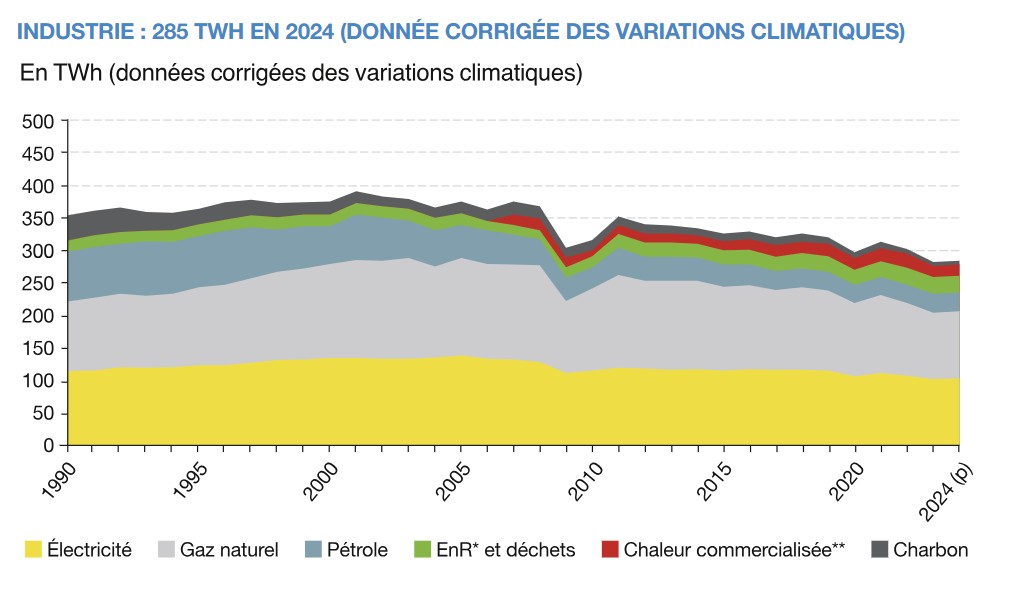
Source: SDES, French Energy Balance
This situation leads to deleterious consequences for France’s energy sovereignty, which finds itself subject to market economic fluctuations. To move beyond this, the PPE 3 sets a reduction in fossil fuel consumption from 900 TWh to 330 TWh by 2030 and relies on several lines of work, including the use of energy efficiency and electrification.
Would you like to reduce your industry’s consumption? Start by conducting an industrial energy audit!
Increased use of energy efficiency and renewable energy among the axes of the PPE 3
The central role of energy efficiency
Among its main axes, the PPE 3 aims to significantly reduce France’s overall energy consumption.
This ambition is in line with the Energy Efficiency Directive (EED). Revised in 2023, it belongs to the Fit for 55 legislative package and presents particularly high targets.
Reduction of final energy consumption between 2023 and 2030:
From 1,510 TWh to 1,243 TWh in 2030 and 1,100 TWh in 2035
In parallel, to promote energy efficiency, the PPE 3 bets on an increase in the production of renewable and recovered heat, with a doubling of its consumption by 2035. Thus, all high-consumption sectors, such as industry, must use waste heat recovery technologies. Furthermore, energy-intensive companies will be subject to energy audits or the implementation of energy management systems.

“The crises we have been going through for several years demonstrate it: energy management is becoming a central profitability factor for manufacturers. However, to improve energy performance, one must first and foremost know their consumption. For this, it is essential to have an exhaustive view of the industrial site’s energy data. Conducting audits or using an EMS (Energy Management Software) coupled with expert support can have several concrete benefits: identifying losses, consuming energy better, renegotiating energy contracts, or even achieving regulatory objectives ( ISO 50001). ”
Sébastien Papouin, Technical Director, Dametis
Dametis supports you in implementing EMS software (Energy Management Software)
Heading towards a decarbonized and predominantly electrified energy system
In parallel with conducting actions in favor of energy efficiency, the PPE 3 sets targets to move towards a sovereign and decarbonized energy mix. To achieve them, it provides for 3 concurrent axes:
Firstly, the PPE 3 sets an increase in the capacities of the existing nuclear fleet and the construction of six new EPR2 reactors.
The PPE 3 also aims to develop the use of renewable and decarbonized energies, both electrical and non-electrical. All have their production forecasts revised upwards, such as hydrogen, biomethane, or even photovoltaics or offshore wind.
Finally, the PPE 3 wishes to encourage the massive use of electrification. To be sustainable, the development of decarbonized electricity production must be accompanied by large-scale electrification of uses.
The PPE 3 includes a review clause by 2027 if electrification targets are not met. This clause will allow for the trajectory to be adjusted if necessary.
650 TWh of decarbonized electricity produced by 2035, representing a 42% increase
compared to 2023.
” In industry, the electrification targets set by the PPE 3 are ambitious and require strong support via incentive measures. While replacing certain gas equipment with electrical equipment is already possible, the investments remain significant for manufacturers: you don’t retrofit a gas furnace to electricity; you have to replace the entire equipment and intervene at the heart of the process! ”
Sébastien Papouin, Technical Director, Dametis
The impacts of the PPE 3 on the industrial sector
A profound transformation of French industry
The acceleration of sovereign decarbonized energies and energy efficiency efforts will necessarily lead to profound transformations in French industry, as the sector accounts for 19% of France’s overall energy consumption.
In the PPE 3, the electrification and decarbonization of the sector are closely linked to reindustrialization. In particular, the energy mix developed in the text is based on a reindustrialization scenario where activities would use decarbonized and competitive energy to power their processes.
Furthermore, for existing industrial capacities, several mechanisms support this transformation. Programs like France 2030 aim to position France as a leader in decarbonization technologies, while being complemented by direct support mechanisms, such as Energy Savings Certificates (ESC), as well as dedicated calls for projects like BCIAT or DECARBIND.

“To succeed in these profound industrial transformations, it is essential to adopt the right methodology. Before any change of equipment or energy source, the site must be analyzed as a whole to have a complete view of its energy consumption. This analysis then allows for informed decisions to be made, taking into account the manufacturer’s needs, constraints, but also the available aid. At DAMETIS, we support our clients with rigor and method at every stage of this process.”
Sébastien Papouin, Technical Director, Dametis
Supporting industrial competitiveness in the energy transition
These transformations aim to strengthen the competitiveness of French industry. To this end, the PPE 3 relies on two axes: increasing low-carbon electricity at controlled prices to face international competition (China, United States), and encouraging decarbonization as well as electrification, particularly in the most exposed sectors.
To guarantee decarbonized, stable, and competitive energy, the PPE 3 provides for measures to control energy costs: compensating for indirect CO₂ emissions of companies exposed to international competition and reducing the network usage tariff for electro-intensive sites and storage facilities, for example.
” To strengthen the competitiveness of our industrial clients, our priority is simple: helping them produce as much while consuming less. To do this, we support them in designing an optimized energy mix, combining different sources (grid electricity, photovoltaics, gas, etc.) to allow them to choose the best option according to their needs and market prices in order to achieve a form of energy resilience at the scale of their sites. ”
Sébastien Papouin, Technical Director, Dametis
The PPE 3 is therefore a structuring text for the future of French industry, with ambitious targets. As a specialist in energy performance, DAMETIS can help you take stock of your situation and your energy consumption.
I would like more information
Error: Contact form not found.