

Stimulating and protecting Europe’s net zero emissions industry
On February 1, 2023, the European Commission launched the “Green Deal Industrial Plan for the Net Zero Emission Era”. In May 2024, the European Council adopted theNet Zero Industry Act (NZIA). 19 “net zero” technologies have been selected, including batteries, wind turbines, heat pumps, photovoltaic equipment, electrolysers, nuclear power and CCUS technologies.
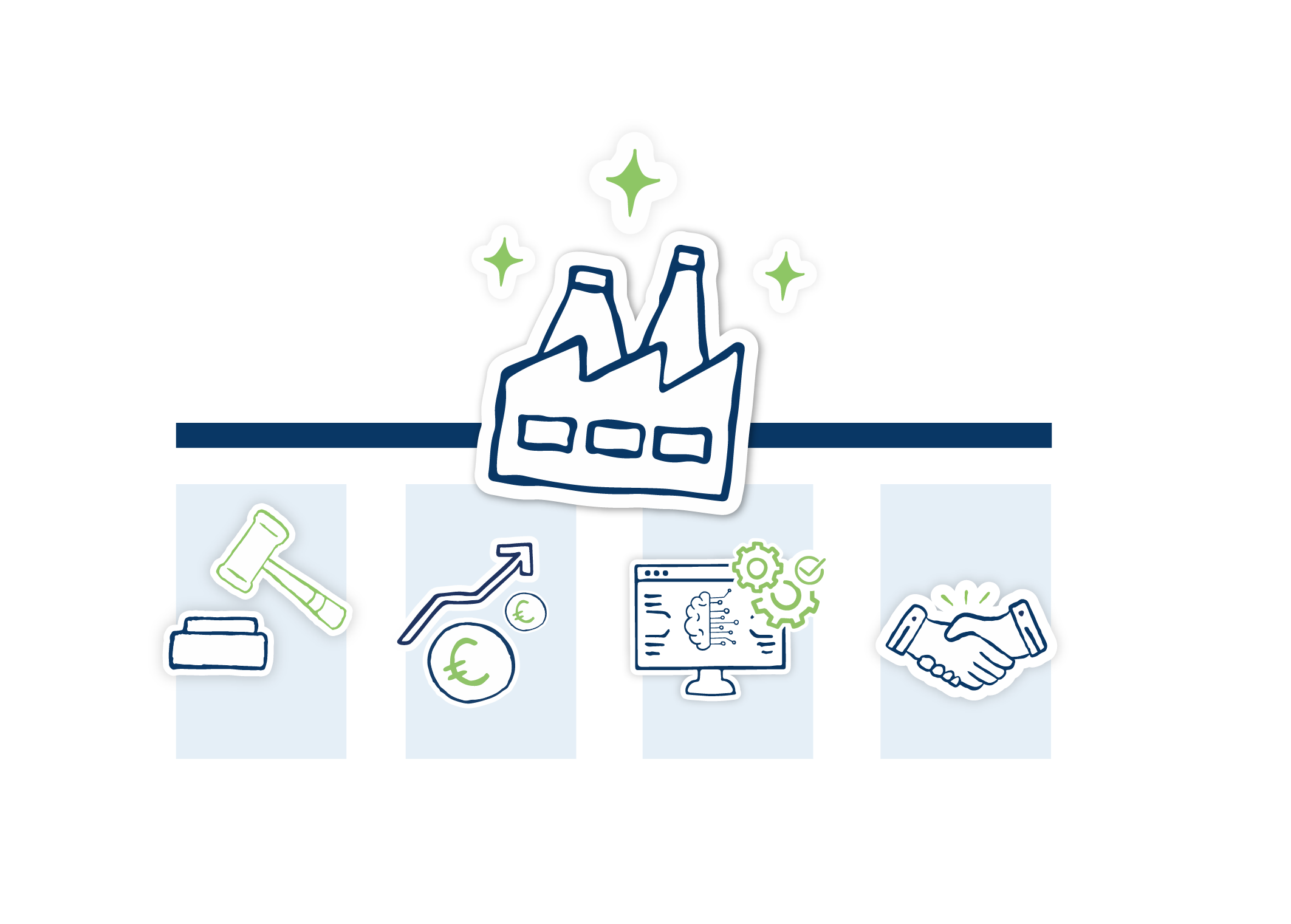
By adopting an industrial plan, the EU aims to stimulate its clean-tech industry. Another aim is to protect it from the unfair practices of its trading partners, particularly China. The Green Deal industrial plan is based on four pillars.
Pillar 1 of the Green Deal: A predictable, consistent and simplified regulatory environment
This first pillar has several components. Firstly, to define a simplified regulatory framework applicable to the production capacities of the equipment needed to achieve carbon neutrality. In particular, it aims to simplify the permitting process for strategic projects and facilitate access for clean technologies in public procurement.
40% minimum
of the equipment needs for clean technologies will have to be produced in Europe by 2030.
Source: European Commission
The second section focuses on the critical raw materials needed to manufacture equipment. 34 have been identified: cobalt, copper, lithium, nickel, tungsten… Today, Europe is highly dependent on external supplies (100% of heavy rare earths are supplied by China, 71% of platinum by South Africa…). In March 2024, the European regulation on raw materials was adopted. It aims to achieve several objectives by 2030:
- At least 10% of the EU’s annual consumption of critical raw materials must be extracted within the Union.
- At least 40% of the EU’s annual consumption must come from processing in the EU (refining, treatment, etc.).
- At least 25% of annual consumption must come from domestic recycling.
- For each strategic raw material, no more than 65% of the EU’s annual consumption should come from a single third country.
Demand for raw materials in the European Union
(high demand scenario), in millions of tonnes per year
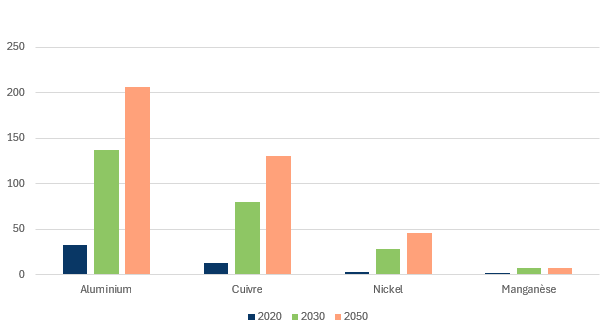
Finally, reform of the European electricity markets is the third major component.
Pillar 2 of the Green Deal: Accelerating access to financing
Numerous programs already exist to finance the transition to a carbon-neutral economy. The 27 national recovery and resilience plans, for example, have earmarked 250 billion euros to finance green measures. The Horizon Europe program, for its part, is endowed with 40 billion euros for research and innovation as part of the Green Deal. As a final example, the EU’s cohesion policy has earmarked €100 billion for the ecological transition. To date, the funds available have been used primarily for research, innovation and the deployment of renewable energies. The aim now is to broaden and facilitate access to financing for the net-zero-emission industry.
National support schemes are at the heart of the European strategy. The Commission aims to increase flexibility in the granting of State aid. Several levers have been identified, in particular simplifying support for the decarbonisation of industrial processes through more flexible aid ceilings per beneficiary, as well as the possibility of granting aid based on a standard percentage of investment costs. Better targeting of support towards new projects in the net-zero industry value chains is also planned. Lastly, Member States will have more leeway regarding the amounts of aid granted to certain key sectors such as carbon capture and storage, zero-emission vehicles, charging infrastructure, and hydrogen.
EU funding will continue to be used. In fact, it will be increased . To facilitate access, a “Strategic Technologies for Europe Platform” (STEP) is currently being set up. The idea is to redirect funding from existing funds (InvestEU, Innovation Fund, Horizon Europe, Cohesion Fund, etc.) into three main strategic areas:
- Disruptive innovations such as microelectronics, quantum computing and artificial intelligence.
- Renewable technologies (electricity storage, alternative fuels, CO₂ capture, hydrogen…).
- Biotechnologies and bioproduction, such as biomolecules and medical technologies.
A “sovereignty label” will be awarded to projects contributing to these objectives, to make it easier for their promoters to attract public and private funding.
The final area concerns private finance. Here, the EU acts as a facilitator, with the ambition of stepping up its efforts to create a more efficient capital markets union. According to the Commission, a single capital market would enable companies to raise funds more easily, while being less dependent on bank financing.
Pillar 3 of the Green Deal: Improving skills
Developing green and digital skills is the third pillar of the Green Deal industrial plan. The Commission intends to carry out a number of actions at the same time, including :
- Objectivize the match between supply and demand by setting targets and indicators for jobs in sectors of interest to the ecological transition.
- Involve cleantech stakeholders in defining skills requirements. With this in mind, a skills partnership for the European renewable energy industry was launched in March 2023. It brings together trade associations, representatives of renewable energy installers, educational institutions and national authorities. Similar initiatives will also be launched in the fields of heat pumps andenergy efficiency.
- Create zero-emission industry academies to train 100,000 workers within three years.
800,000 new jobs
expected in the battery industry between 2022 and 2025 in Europe.
Source: European Commission
Pillar 4 of the Green Deal: Resilient trade and supply chains
The development of trade with partners outside the EU is a key element of the EU’s strategy under the Green Deal industrial plan. With this in mind, the EU will continue to promote international cooperation through the World Trade Organization (WTO) and free trade agreements. New initiatives will also be deployed: the creation of a critical raw materials club to guarantee secure and sustainable global supplies, the development of industrial partnerships and the implementation of an export credit strategy.
While the EU is committed to opening up trade, it also wants to ensure that fairness is respected. It wishes to protect its market and its companies against distortions of competition. Dumping strategies and subsidies are particularly targeted. The European Commission notes, for example, that the market is distorted by massive Chinese subsidies for innovation and production in the field of clean technologies. It will continue to use WTO trade defense instruments to correct the effects of unfair practices favoring imported products.
The EU has also introduced a Foreign Subsidies Regulation, which came into force in January 2023. This tool makes it possible to investigate subsidies granted by third countries. Finally, the screening of foreign direct investment in the Union will be reinforced.
Up to 35
the level of additional customs duties applied to electric vehicles manufactured in China and imported into the EU. The principle was approved by EU member states on October 4, 2024.
Source: European Commission
Talk to an expert
Error: Contact form not found.