

The recast of the Energy Efficiency Directive introduces an obligation to set up an EMS
Recasting of the Energy Efficiency Directive as part of “Adjustment to Objective 55”.
To achieve carbon neutrality by 2050, the European Union has raised its target for reducing greenhouse gas emissions to at least 55% below 1990 levels by 2030 (compared with the previous target of 40%). This ambitious target requires the adaptation of various European regulations within a legislative package known as the “Adjustment to Target 55” package. It covers a number of areas, including the Emissions Trading Scheme, renewable energies, energy taxation and, of course, energy efficiency.
It is against this backdrop that the 2012Energy Efficiency Directive has been recast. The new version was published on September 13, 2023.
A target of 11.7% energy savings by 2030, but in reality much more than that
The directive sets a consumption reduction target of at least 11.7% by 2030 (compared with a previous target of 4.5%), compared with the projections of the Union’s 2020 reference scenario. In other words, we’re not talking about energy savings in relation to actual reference consumption, but in relation to anticipated energy consumption.
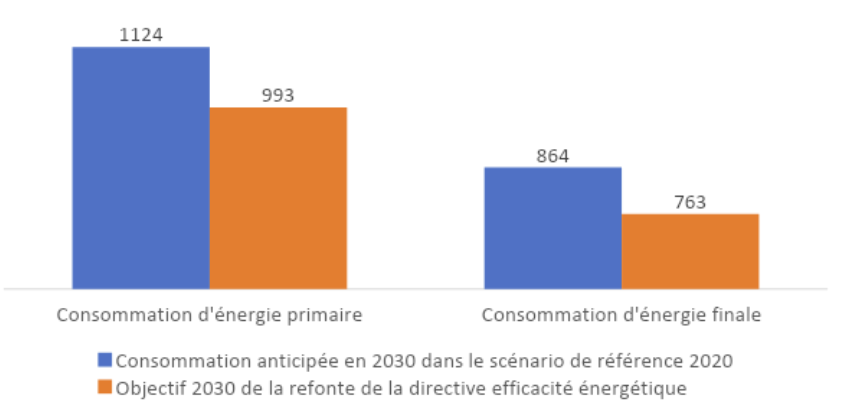
Source: Directive 2023/1791
The directive stipulates that “Member States shall collectively reduce energy consumption (…) so that the Union’s final energy consumption does not exceed 763 Mtoe” by 2030. It also states that “Member States shall strive to contribute collectively to the achievement of the European Union’s indicative primary consumption target of no more than 993 Mtoe by 2030”. These ceilings correspond to an 11.7% reduction compared to projected energy consumption in 2020. But by this date, consumption had finally exceeded expectations.
In its 2020 reference scenario, the EU forecast primary energy consumption of 1,177 Mtoe, whereas according to Eurostat data, the final figure was 1,236 Mtoe. Not exceeding 993 Mtoe therefore represents a saving of almost 20%! And in relation to primary consumption in 2022, the target is even just over 21%.
The same applies to final energy consumption. The EU consumed 906 Mtoe in 2020 and 940 Mtoe in 2022, so the 2030 target in relation to these two references is -16% and -19% respectively.
Indeed, the European Environment Agency has expressed doubts about the EU’s ability to meet its energy efficiency targets. Unless – and this cannot be ruled out – even more stringent measures are subsequently introduced. Last September’s recasting of the Energy Efficiency Directive is undoubtedly only a first step.
Member states urged to do more
The Energy Efficiency Directive calls on Member States to set national targets for final energy consumption, with the aim of achieving the collective final energy consumption objective of 763 Mtoe by 2030. It goes even further, by setting annual energy savings targets. Member States are now subject to the following obligations:
- 1.3% end-energy savings per year by 2024 and 2025
- 1.5% end-energy savings per year in 2026 and 2027
- 1.9% end-energy savings per year between 2028 and 2030
As a result, member states will have to step up their efforts significantly. To encourage them to make energy savings, the directive provides for various measures. In particular, it targets public-sector players, specifying that the public sector must play a leading role in energy efficiency. It even sets a target of reducing the final energy consumption of all public bodies by at least 1.9% per year (relative to the 2021 reference year). Public buildings are also heavily involved, with the directive setting atarget of renovating at least 3% of the total surface area of buildings owned by public bodies.
The directive also pays particular attention to people in fuel poverty, as member states are required to devote part of their efforts to this population. It also provides for the implementation of energy efficiency obligation mechanisms, a system that already exists in France with the energy savings certificates.
Setting up an energy management system
For companies, one of the main direct impacts of the recast of the Energy Efficiency Directive is the obligation to set up an energy management system (EMS). This measure only concerns companies whose consumption over the past three years has, on average, exceeded 85 TJ (terajoules) per year, or 23.6 GWh. All energy carriers (electricity, natural gas, etc.) are included in this calculation. Companies affected by the mandatory introduction of an energy management system have until October 11, 2027 at the latest to comply.
Companies whose average annual energy consumption has exceeded 10 TJ (2.8 GWh) over the past three years, and which are not implementing an energy management system, must undergo an energy audit. The first industrial energy audit must be carried out by October 11, 2026, and renewed every four years thereafter. An action plan will then be drawn up based on the audit recommendations.
Both categories of company are also required to make the data they collect available to national authorities. Lastly, the directive encourages Member States to encourage companies to include energy and water consumption data in their annual reports.
In industry, setting up an energy management system can be complex and time-consuming. To simplify this task, many manufacturers opt to implement an EMS (Energy Management Software, also commonly known as an energy management system) or EMOS(Energy Management and Optimization Software).
Linked to sensors placed within the industry, theEMS will enable data to be collected in real time and easily tracked, any anomalies to be detected and, finally, solutions to be recommended with an impact on energy performance. But… EMOS goes further, as it addresses the operational needs of all the company’s businesses in terms of energy and water management. This tool standardizes indicators and work methodologies from one site to another. In this way, it facilitates drift monitoring and data analysis, enabling teams to make informed decisions and implement corrective actions. EMOS makes it easier to draw up a detailed action plan tailored to ISO 50001.
How about our MyDametis software? The only software 100% designed by experts. Placed within your plant, our energy management system (EMS/EMOS) collects your data, models your plant, detects deviations and recommends the best solutions to achieve your objectives in terms of energy and environmental performance.