


Despite its efforts, France is struggling to reduce its CO2 emissions. France has pledged to reduce its CO2 emissions by 40% by 2030, an ambition that needs to be stepped up to take account of new European targets (-55%).
Unfortunately, recent figures show that France’s CO2 emissions have risen slightly in recent years.
The main reason for this lack of progress is that France is struggling to adapt to the energy transition, which means it is finding it hard to reduce its dependence on fossil fuels and promote renewable energy production.
Measures taken by France
France has taken a number of steps to reduce its greenhouse gas emissions.
It has introduced policies to limit greenhouse gas emissions, encourage the use of renewable energies, promoteenergy efficiency and apply taxes on fossil fuels. France has also adopted the Climate Plan, which provides a framework for implementing policies and measures to reduce greenhouse gas emissions.
The initiatives taken by France should have a positive impact on its emissions in the long term, provided the country continues to invest in sustainable, low-carbon solutions.
It also includes programs to promote the development of renewable energies, including wind and solar power, and to improve transport efficiency. Reductions in greenhouse gas emissions will also be supported by mitigation measures such as forest improvement, land management and the maintenance of fertile soils.
To compensate for its nuclear fleet and transportation difficulties, France is turning more and more to fossil fuels. As a result, the country is working hard to reduce its carbon dioxide emissions. Greenhouse gas emissions were virtually unchanged (-0.3%) in the first nine months of this year compared with the same period in 2021, according to provisional data from Citepa (Centre interprofessionnel technique d’études de la pollution atmosphérique), the agency responsible for compiling France’s emissions inventory.
Industry contributes to rising greenhouse gas emissions
The main sources of greenhouse gas emissions in industry are factories and industrial activities that produce and consume fossil fuels such as coal, natural gas and oil.
These fuels are burned to produce energy, releasing greenhouse gases into the atmosphere.
Other sources of greenhouse gas emissions in industry include plants that produce chemicals and plants that produce manufactured goods. Production processes, which include fuel refining, steel and aluminum production, wastewater treatment and chemical manufacturing, are also major sources of greenhouse gas emissions.
Emissions from general industry nevertheless fell by 5% (53.9 tonnes of CO2 equivalent), according to Citepa. This includes -2% for chemicals, -5% for food processing, -11% for ferrous metals and -4% for non-metallic minerals and building materials.
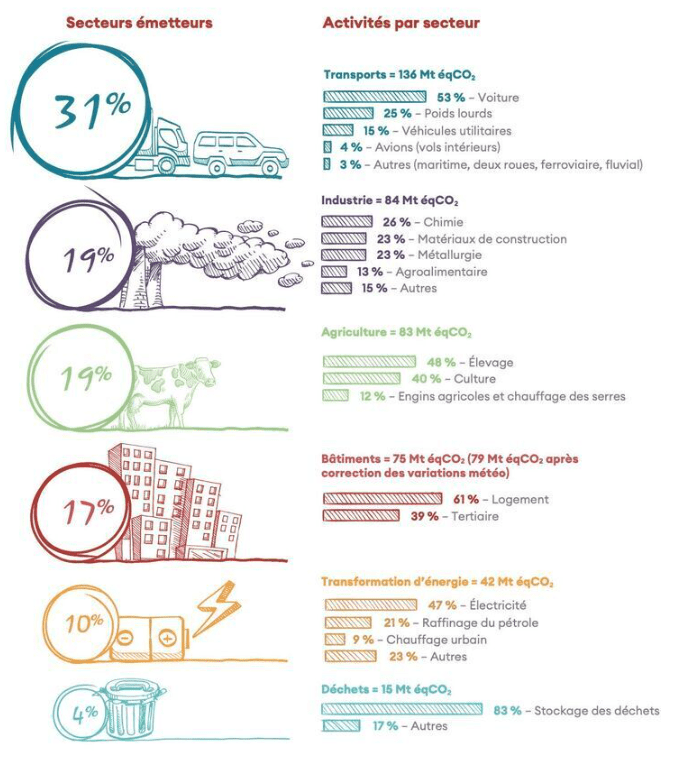
C02 emissions by sector in France
Greenhouse gases and CO2 are closely linked. Greenhouse gases are gases that absorb and retain heat in the earth’s atmosphere. CO2 is one of the main greenhouse gases and is responsible for over 65% of the greenhouse effect. Other greenhouse gases include methane, nitrous oxide and nitrous oxide. Concentrations of these greenhouse gases are rising sharply, leading to higher average temperatures and climate change around the world.
The main sectors that emit greenhouse gases are the following:
- Transport: cars, trucks, planes, boats,
- Industry: energy production, use of chemical agents and factories,
- Agriculture: farming practices, animal husbandry,
- Buildings: construction, heating and air conditioning,
- Waste: landfills, incineration,
- Forestry activities: deforestation and forest fires.
The Haut Conseil pour le Climat, in its 2021 report for the general public, gives similar orders of magnitude, summarized in this infographic (based on the CITEPA report):
How can you reduce greenhouse gas emissions?
There are several measures we can take to reduce greenhouse gas emissions:
- Make more efficient energy choices by installing renewable energy systems (solar, wind, geothermal, etc.) and energy efficiency technologies.
- Reduce waste and recycle more to avoid methane emissions from landfills.
- Make buildings more energy-efficient by using insulating materials, installing energy-saving equipment and using renewable energy sources.
- For companies: adopt more sustainable practices and reduce their greenhouse gas emissions.
- Use more sustainable and fuel-efficient means of transport, such as cycling, public transport or carpooling.
Imagine having specialists working 24/7 to optimize your industrial sites. That’s what MyDametis offers you, the only platform designed 100% by experts in environmental performance.

Conclusion
This relative stabilization of greenhouse gas emissions is not good news. If France is to meet its climate commitments, it must redouble its efforts.
According to the government’s roadmap for combating climate change, the Stratégie Nationale Bas Carbone (SNBC), France must reduce its emissions by an average of 16 million tonnes by 2030, i.e. by 4.7%.
Would you like support in your organization’s decarbonization strategy?
Dametis can help you optimize the environmental performance of your plants to control costs, consume fewer resources and reduce your carbon footprint.