

Planet-score: is it compulsory for food manufacturers?
A descriptive text to introduce the page and whet the appetite for more.
What is environmental labelling in the food industry?
The aim of environmental labelling in the agri-food sector is to inform consumers about the environmental impact of food products. For this purpose, several labels have been developed, and the Planet-score is the one that has been chosen. It provides consumers with relevant, objective information. It enables them to compare products when making their purchases, and to favor environmentally-friendly products. The Planet Score is designed to encourage food manufacturers to reduce their impact on the environment and make efforts in terms of eco-design.
Planet-score: definition
You already use the Nutri-score, the label that informs your customers about a product’s nutritional values. The Planet score is a second label making its debut with food industry professionals.
The scheme was introduced following the Agec (Anti-Waste Circular Economy) law of February 2020 and the Climate and Resilience law of August 2021. A call had been launched to create an environmental display system for the food industry in the form of a label. Planet-score was selected.
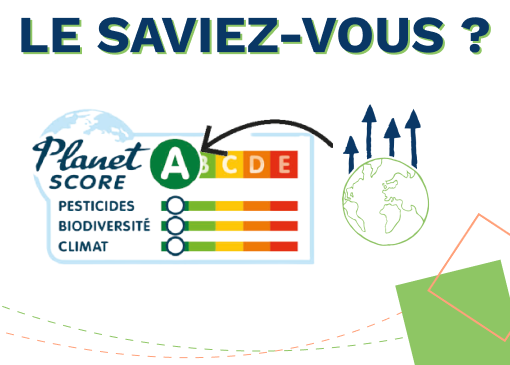
This label displays environmental criteria. A rating from A to E is assigned according to 3 sub-indicators:
- Pesticides: the use or non-use of pesticides.
- Biodiversity: the impact of farming practices on biodiversity.
- Climate: soil carbon storage and greenhouse gas emissions
In addition to these criteria, there is also an indicator on animal welfare (this sub-indicator concerns products containing at least 5% animal products (for pork, poultry, beef or sheep farms). The score is displayed as a color: either green, orange or red.
The aim of the Planet-score is very clear: to combat the decline in biodiversity, climate change, air and water pollution, deforestation, and so on. And to do so by informing consumers about the environmental impact of food. It calls for a general awareness, without greenwashing and with transparency.
France is not alone: dozens of countries have also committed to this approach, including the UK, Italy, Spain and Germany.
Planet-score: mandatory for manufacturers?
Until now, environmental labelling in the food industry has been voluntary. However, Planet-score should gradually become mandatory by 2024 or 2025. A decree will be issued in 2023 to specify the methodology and final details of the system.
However, manufacturers have every interest in adopting environmental labelling and Planet-score right now. There are a number of advantages:
It’s a way to stand out from the competition by responding to consumer demand for a better understanding of the environmental impact of food, and the ability to compare foods in the same category. Consumers are increasingly attentive and demanding on these issues, and are likely to favor “transparent” products in the future.
Better knowledge of products and identification of possible areas for improvement before the Planet-score is made mandatory.
Manufacturers also have every interest in anticipating regulations. For the moment, environmental labelling in the food industry is voluntary. Planet-score could become mandatory as early as 2023.
All food products are covered: fruit, vegetables, pulses, cereals, meat, eggs, ready meals, etc.
How is Planet-score calculated?
The Planet-score is calculated using a number of indicators, including :
⇒ State databases, in particular ADEME’s Agribalyse;
⇒ The impact of agricultural practices on biodiversity;
⇒ IPCC (Intergovernmental Panel on Climate Change) data;
⇒ The origin of ingredients, cultivation/breeding methods, packaging used, transport, etc.
⇒ The LCA (Life Cycle Assessment) method, and improvements to this method as it is incomplete for the food industry. This method is used in particular to assess the use of pesticides.
When a product is made up of several ingredients: each element is scored, and a pro rata is applied according to the quantity of each ingredient, to obtain an overall score.
This process should enable food manufacturers to identify where their margins for improvement lie.
Farming methods are part of a separate assessment. The criteria are based on a grid created by the animal protection NGO CIWF France.
What do food manufacturers need to do?
Here are ADEME’s recommendations for using Planet-score:
⇒ Raising awareness: the first step is to fully grasp the stakes involved and the commitments to be made. We also need to think about the best way to implement environmental labelling, particularly in terms of the technical and logistical framework.
⇒ Commitment: the company defines which departments will be involved in the process and what this entails. It will also be necessary to define the scope of the project and take stock of available resources.
⇒ D ata collection: the industrialist collects all the data specific to each product so as to be able to evaluate them later. Some of this data may have to be collected externally, from various players in the industry.
⇒ Environmental assessment of products: the data collected is analyzed to calculate the environmental impact of each food product. A life-cycle analysis tool must be used.
⇒ Analysis of results and assignment of scores: a score ranging from A to E is assigned to the various sub-indicators for each product.
⇒ Verification of scores: a person selected by ADEME will check the conformity of the data, the tools used and the scores awarded.
⇒ D isplaying scores: once everything has been validated, scores can be displayed on foodstuffs via Planet score.
Find out how Dametis can help you limit your environmental impact and improve the Planet-score of your products: