


Evolution of energy regulations in Canada in the industrial sector
Canada, like many countries, must reduce its greenhouse gas emissions. However, the Canadian government has chosen an approach based on economic pressure. Today, no law requires industrial companies or any other emitting business to reduce its carbon footprint.
Nevertheless, in 2025, a major tightening of the regulatory landscape in Canada is being observed. Companies are being pushed to reduce their GHG emissions and, consequently, their energy consumption: carbon pricing continues to rise, the cap set on emissions per unit of product is becoming stricter, and Canada is now reintroducing subsidies to support the transition to ISO 50001 certification.
Although there is currently no obligation, it is advisable for the most energy-intensive companies to take action now. Given the climate emergency, it is unlikely that no regulations will be introduced in the near future. This is precisely why it is essential to inform industrial stakeholders as effectively as possible, starting now, about EMIS, an essential tool to streamline their EnMS (Energy Management System).
Would you like to reduce your carbon footprint?
What is a SIGE?
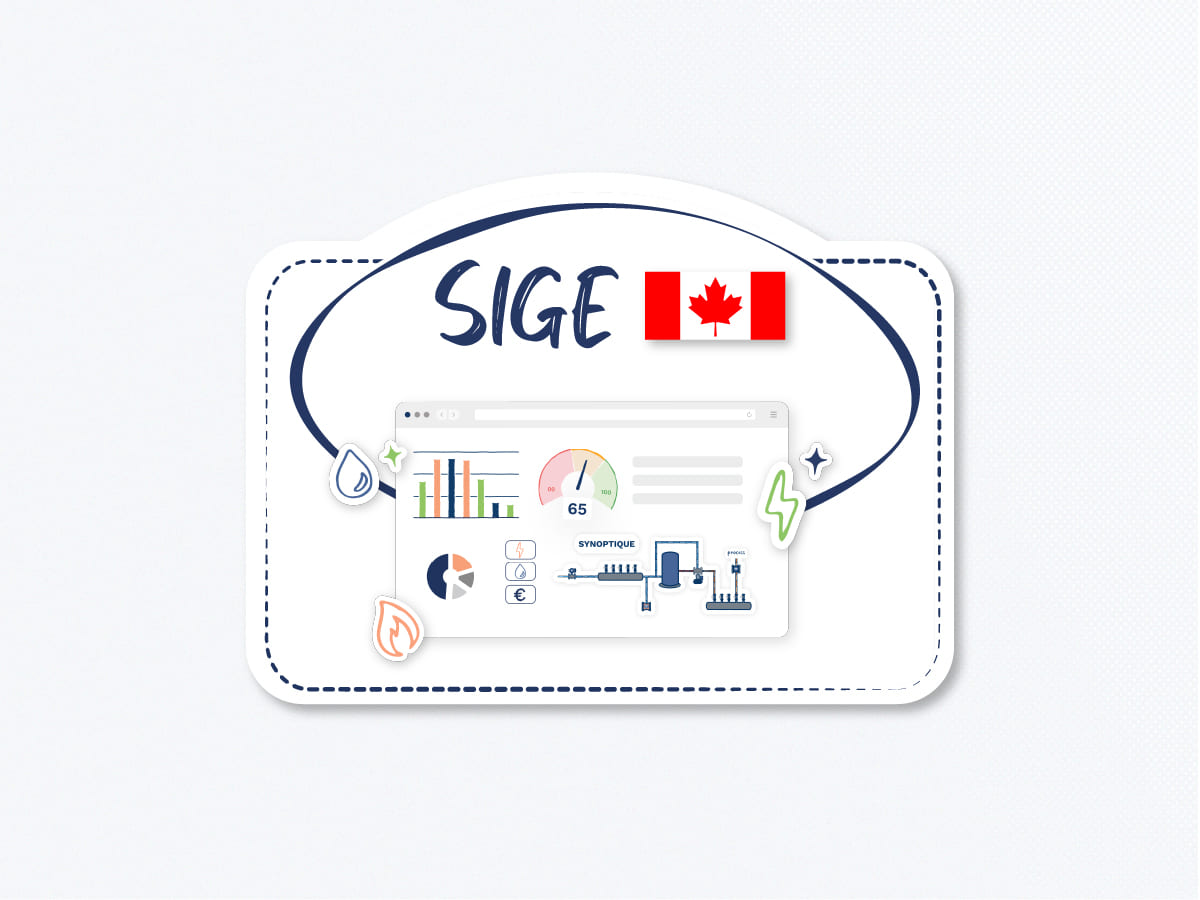
The Energy Management Information System (EMIS) is a term used particularly in Canada. It refers to software—a digital platform—designed to optimize, improve, and sustain industries’ energy efficiency and environmental performance.
In France, this platform is more commonly referred to as EMS software.
Connected to sensors installed on the plant’s equipment, this software collects and processes data related to energy and water.
To ensure better energy and environmental performance in plants, SIGE integrates, beyond consumption data, various data points that influence production and equipment. For example, it takes into account weather data, data related to energy contracts, and the equipment in place.
This data is then processed and analyzed by the EMIS. Depending on the activity and objectives, the EMIS makes it possible to monitor a very wide range of indicators, such as:
- Energy consumption per recipe produced
- Changes in energy consumption during maintenance phases
- The difference in consumption between two similar installations, but with equipment of different ranges or generations.
An EnMS (Energy Management System) is an approach aimed at monitoring, measuring, and continuously improving energy consumption, inspired by the ISO 50001 standard. This approach, generally managed in Excel, is not automated and therefore becomes very time-consuming and potentially unreliable.
To address these steps and make the EnMS more reliable, integrating a SIGE within your industrial operations proves to be a powerful tool.
Would you like to implement a SIGE?
What are the benefits of a SIGE as part of an EnMS?
While an EnMS alone provides many benefits to the industrial company that implements it (energy savings, reduced carbon footprint), implementing a SIGE not only makes it easier to monitor and sustain the EnMS, but also multiplies the benefits for industrial players.
First, it should be noted that SIGE is a flexible tool that helps bring different teams together around energy topics, even though the tool processes complex, highly technical field data. Its interface is designed to be customizable so that each role can quickly view the KPIs relevant to them.
- IT Management: rationalization of tools by opting for a single software solution, providing a SaaS that is easy for different teams to use.
- Industrial Management: ability to track overall KPIs and benchmark across different sites, enabling informed decision-making.
- Field operators: readings are automatic, reports are automatic, deviations are detected quickly, etc.
- Energy Management: easier achievement and maintenance of ISO 50001, real-time visibility of energy results, optimization of site operations.
Simply looking at the key features of SIGE makes it clear how these benefits translate into day-to-day operations.
Key features of SIGE
Consumption monitoring
Real-time monitoring for energy vectors
Consumption monitoring
Real-time monitoring for energy vectors
Data quality
Standardize and contextualize data to make it usable
Optimization
Deviation detection and optimization thanks to built-in AI
Optimization
Deviation detection and optimization thanks to built-in AI
ISO 50001 certification
Support across the entire standard to facilitate achievement and ongoing compliance
Enterprise view
Managing the performance trajectory
Benchmarking
Performance comparison by sector and equipment type
Regulatory compliance
Discharges, emissions, drilling…
NEP management
(Clean-in-Place)
Wash log, TACT tracking, Golden CIP
Smart Control
Dynamic setpoints for optimal operation
Budget control
Simulation, invoice validation, and budget forecasting
In summary, SIGE becomes your true ally by enabling you to:
- Save time (fewer files, fewer manual entries…)
- Sustain your performance over time
- Focus on energy-saving projects
- Increase your teams’ operational performance
- Anticipate potential tighter regulations regarding the implementation of an EnMS
Would you like to implement an EMIS or obtain more information on this topic? Contact us!
I would like more information
Error: Contact form not found.