


Energy Management Software (EMS): all you need to know
EMS stands forEnergy Management Software, which can be translated as “energy management system”. It’s a broad name referring to the many possible optimizations within your industry. Dametis can help you achieve your decarbonization objectives with EMS.
What is Energy Management Software?
EMS software enables you to optimize your plant’s energy consumption. This tool is linked to sensors that will be installed on your installations, enabling you to collect data from your plant, which you can view directly from the software interface. The software measures energy consumption at different levels of your plant, and correlates these measurements with a number of indicators, such as :
- The carbon impact of the energies used
- Time of day
- Productivity
Depending on your business, your objectives and the scope of your EMS deployment, you’ll be able to track a vast number of indicators. For example :
- The energy consumption dedicated to the production of product A compared to that of product B,
- The evolution of energy consumption during maintenance phases,
- The difference in consumption between two similar systems, but from different ranges or generations.
- Etc.
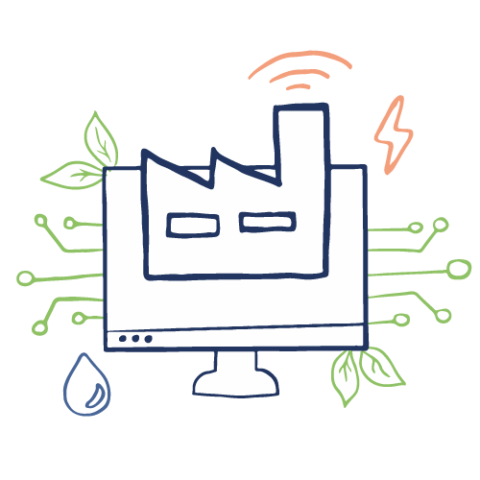
Once all this data has been collected, it needs to be analyzed and put to good use to reduce your industry’s energy consumption. This is where theEnergy Manager comes in.
How does an EMS work?
Energy Management Software is a tool that combines the expertise and knowledge of experts with a software platform featuring a powerful algorithm.
Thanks to this alliance, Energy Management Software will be able to :
- Recommend solutions to improve your energy efficiency
- Collect data from your plant
- Model and compare your plant with your ideal plant
- Detect and prevent any anomaly or drift

Who can use Energy Management Software?
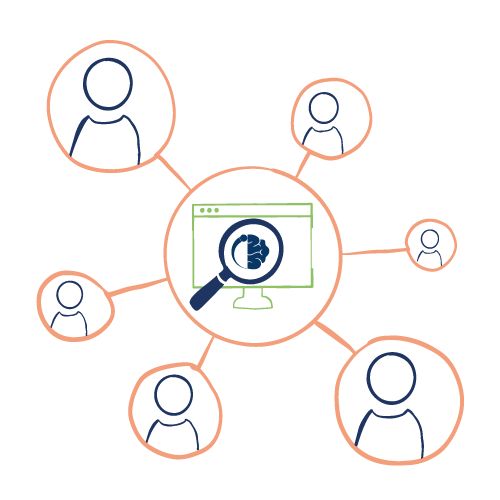
EMS can be used by all business lines. This tool will enable everyone to gain in autonomy and have precise monitoring of their activity’s KPIs.
The EMS will then bring together all the professions at different levels (e.g. plant technicians, plant managers, industrial management, IS, finance, and other head office professions). to unite all employees around energy efficiency and the environment. Each industry sector will be able to take advantage of this EMS to analyze the data it needs to carry out its missions, on a daily basis and in real time.
Staff will be able to co-construct the tool with the expert, and determine the elements to be monitored in the EMS. In this way, the tool will be configured so that the relevant data and indicators are displayed on the interface. The aim is to help people make the EMS and its intuitive interface their own. Once the sensors have been installed and the data begins to flow into the tool, the caller will know..:
- Analyze them
- Identify anomalies and deviations
- Identify the most energy-intensive parts of the production chain
- Detect instances of energy loss
- Detect any technical faults that may be the cause of overconsumption
- Confirm hypotheses by comparing observations with other data
- Validate acceptance of new equipment
- Maintaining energy performance
The work with EMS doesn’t stop there:
once the defects and anomalies have been detected, the industrialist will be able to resolve them, or at the very least to participate in their resolution by identifying areas for improvement.
Based on the various conclusions drawn from the analyses, each industry sector will be able to :
Define the appropriate action plan, taking into account :
- Economic objectives
- Productivity targets
- Green objectives
- Etc.
Convincing decision-makers to implement these actions :
- Actions with budgeted costs
- Actions with a predictable impact
Design and implement new processes by :
- Studying and mobilizing appropriate service providers
- Ensuring that employees are informed and trained in the use of new processes
Control energy costs
Negotiating energy contracts
Bringing this continuous improvement approach (like ISO 50001) to life
With such a broad scope, EMS has the potential to meet the needs of every industry. If you’d like more support in understanding this tool, or if you feel the need for more resources on EMS, our experts are here to help you and answer all your questions.
Why install an EMS?
EMS is a tool with a very powerful algorithm, offering you a multitude of benefits: real-time visibility, drift detection, work recommendations, plant modeling, time savings, simplified application ofISO 50001…
When properly configured, Energy Management Software is able to adapt to your activity, your staff, your objectives and your current level of energy performance.
This tool is thus capable of adapting to all trades involving energy, water or materials.
For energy-related professions, EMS will be beneficial in: detecting the most energy-hungry equipment, detecting any anomalies (overheating, overconsumption, etc.), implementing corrective actions or recommending solutions such as improved equipment regulation.
For the water industry, this tool will prove to be an invaluable ally for: mapping consumption, reducing water consumption, optimizing CIP (Cleaning in Place), WWTP (Wastewater Treatment Plant) and your treatment lines, step by step.
For businesses more focused on materials, EMS will enable you to: identify the source of material losses, reduce them, cut the extra costs associated with them, and train your teams in materials management. More generally, Energy Management Software will enable you to reduce your carbon footprint, cut your energy bills and reduce your water consumption. The result is a significant reduction in production unit costs, with the aim of achieving the lowest achievable cost.
Installation steps
for Energy Management Software
An EMS needs to be set up carefully: it’s not enough to simply associate the software with all the installations. If these steps are not followed, you will end up with a mass of data that will be extremely difficult to link together. To obtain usable data, it’s essential to :
Define improvement targets, based on an industrial energy audit or carbon footprint, for example
Target the installations to be monitored and grouped together, so that data can be displayed in a coherent, usable way.
This is followed by sensor installation and software parameterization, to display data at micro and macro levels.
The final step is to ensure that you will be accompanied by an expert. This can take the form of training in the use of your EMS by the installing organization, or ongoing external support.
Pitfalls to avoid when setting up an EMS
There are several warnings to be heeded before installing an EMS:
Define objectives beforehand, so that the tool can be configured to suit your needs
- Define the technical uses to be tracked
- By the day or month
- Indicators to be displayed opposite
- Prepare a list of measures already in place
Draw up a measurement plan (PDM) to recommend the measures to be added and outline the total budget in relation to requirements
Plan for real data tracking over time
Be accompanied by a trained reference person
Draw up a measurement plan – actual data
Dametis can advise you on which devices to prioritize. Some companies opt for a phased installation of their Energy Management Software.
The advantages of using EMS software
Why use an EMS rather than other decarbonization solutions, such as regular audits with manual measurements?
EMS software offers several advantages over time. Once in your plant, the software enables continuous improvement of your installations, and there’s no need to repeat a complete audit of the production site. You will, however, need to think about installing new sensors if you need to replace part of your production line.
What’s more, Energy Management Software’s interface is simple, intuitive and allows you to compile data to display improvements over time in a visual and interactive way. This will enable you to show your company’s progress to employees, management or potential customers and investors.
Dametis supports you
in decarbonizing your industry!
Dametis experts can help you find ways to optimize your production line. This may involve installation of the EMS My Dametis software and consulting support.
However, Dametis expertise doesn’t stop there. We also offer industrial energy audits, environmental performance consulting and industrial energy training delivered by Dametis Academy experts.