

PPE 3: All low-carbon energy production sectors will be involved
As part of the work on the French Energy-Climate Strategy, the objectives of the next Pluriannual Energy Program, the third, known as PPE 3, were unveiled for consultation last November.
+34%
Decarbonized electricity generation is expected by 2035 compared to 2021, i.e. at least 640 TWh
Sources: Ministry of Energy Transition, RTE
Two main points emerge. The first is that all decarbonized energy production sectors will be called upon to contribute. Firstly, decarbonated electricity (nuclear and renewable energies), directly linked to the growing electrification of uses. Non-electricity sources (renewable heat, biofuels, etc.) will also make their contribution to decarbonizing the country.
Secondly, the objectives are ambitious. The aim is to accelerate the development of most decarbonized energy production sectors.
Triple renewable electricity production by 2035…
According to projections by the French Ministry of Energy Transition, nearly 200 TWh of additional renewable electricity (compared with 2022) will be needed by 2035, i.e. a threefold increase. This implies a sharp acceleration in the development of the main production sectors.
Targets for installed capacity in renewable electrical energy
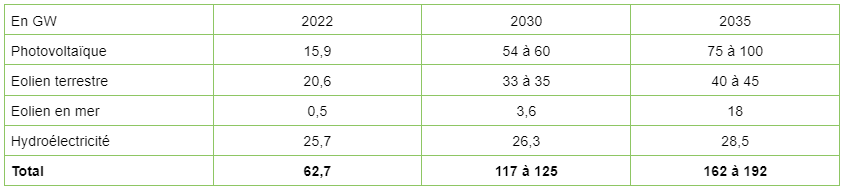
Photovoltaics is the sector with the highest ambitions. The PPE 3 could see a deployment rate of at least 5.5 GW per year, with a target of 7.5 GW per year. This represents a sharp acceleration, given that in 2022, installed capacity for the year stood at 2.4 GW. The government hopes that this development will be balanced between ground-mounted farms, large-scale rooftops and residential applications. Agrivoltaics (photovoltaic installations on working agricultural plots) is also envisaged, with the development of an appropriate regulatory framework. Incentives for self-consumption, both for businesses and the residential sector, will be stepped up.
For onshore wind power, the aim is to maintain the current rate of deployment, at around 1.5 GW per year. However, a better territorial distribution is expected. On the other hand, the EPP 3 is set to accelerate the development of offshore wind power. Given the lead times for commissioning offshore wind farms, it is over the period 2030-2035 that the effort will be most visible. An additional 10 GW should be allocated between now and 2025 via calls for tender to meet the target. One of the key issues set out in the draft PPE 3 is planning. The government wants to implement comprehensive planning for the different maritime façades.
Lastly, installed hydroelectric capacity is set to increase slightly, mainly on existing facilities, as the potential for new infrastructure is limited. One of the measures under consideration is to encourage the renovation of small hydroelectric plants.
…supporting the country’s industrialization
For the government, the development of decarbonized energy production is an opportunity toincrease the country’s industrial capacity by localizing or relocating the production of equipment required for the energy transition. Among the sectors identified are solar power (photovoltaic panel manufacture in particular), wind power (manufacture of various wind turbine components), heat pumps and electricity networks.
The offshore wind pact
In March 2022, the French government and the offshore wind industry signed a pact with mutual commitments. In particular, the French government announced a target of 18 GW by 2035, included in the draft PPE 3. For its part, the industry has pledged to invest more than 40 billion euros over 15 years, and to achieve a local content of 50% calculated on the share of costs for each project.
The modus operandi should take the form of an industry pact, along the lines of that for offshore wind power, drawing in particular on the possibilities offered by the Net-Zero Industry Act. This European regulation, adopted in 2023, aims to facilitate and promote the development of a European energy transition industry, in particular via calls for tender to benefit from financial support mechanisms. The France 2030 plan will also be used to support innovation and structure industrial sectors.
The question of supplies of critical metals (lithium, cobalt, rare earths, copper, etc.) to enable the manufacture of energy transition equipment will be addressed by PPE 3. The stated aim is to control the value chain, from extraction to recycling. Several levers will be (or will continue to be) used in these areas, notably the France 2030 Critical Metals call for projects and the green industries tax credit. To assess the mineral wealth of our subsoil, an exploration campaign will be launched in 2024.
Finally, training has not been forgotten. The State, the Regions and the sectors will have to work together to define needs and set up a framework for skills development.
Double renewable heat consumption
Renewable heat production targets
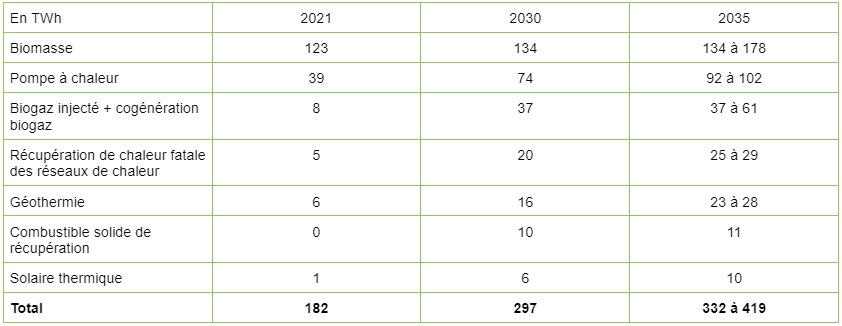
EPP3 forecasts a leap in heat consumption from a wide range of production sources. Biomass, heat pumps and biogas are expected to drive growth in renewable heat production. Geothermal energy, solar thermal energy and the recovery of waste heat from heating networks will also play a role.
In addition to these volumes, heating and cooling networks are set to grow significantly, as the government is aiming for 4.5 to 5.2 million additional homes to be connected by 2035 (compared with less than 1.3 million in 2020). What’s more, a growing share of their production will have to come from renewable energy sources (80% by 2035, i.e. 90 TWh, compared with just over 60% at present, i.e. around 20 TWh).
Particular attention will also be paid to the recovery of industrial and tertiary waste heat. The PPE 3 plans to require a study of the recovery potential for all existing industrial units over 10 MW and new units over 5 MW.
+225 M€
Increase in the Fonds chaleur budget in 2024 to bring the total envelope to €820 million
Source: Ministry of Energy Transition
Three existing support schemes are designed to help achieve these objectives. For private customers, there is MaPrimeRénov’, dedicated to financing energy renovation projects. The Fonds chaleur (heat fund) finances renewable heat production projects in various sectors (collective housing, tertiary sector, agriculture and industry). By way of example, a biomass-based project in the industrial sector producing between 1.2 and 12 GWh of heat per year may be eligible for assistance from the Heat Fund.
Finally, the decarbonization component of the France 2030 plan can be mobilized by the industrial sector in the field of renewable heat.
Moving from advanced biofuels to synthetic fuels
PPE 3 could set out a two-stage roadmap. In the short term, the aim is to develop the production of so-called advanced biofuels, derived from resources that do not compete with food (residues, waste or co-products). These advanced biofuels will complement first-generation biofuels derived from agricultural resources that can be used for food.
In the longer term, the electrification of light mobility will enable its decarbonization. For heavy mobility (air transport, shipping, fishing, etc.), biofuels and synthetic fuels (e-gas oil, e-kerosene, etc.) as well as hydrogen are the solutions under consideration. Hydrogen will be the subject of our next article, to find out all about France’s hydrogen strategy.