



The agri-food industry requires high levels of energy consumption, particularly for product processing and packaging.
Energy consumption includes heating, cooling and hot water production. We’ll see in this article that other activities also consume a lot of energy.
To reduce energy consumption, the food industry can adopt a number of measures, such as improving theenergy efficiency of machines and processes, or using renewable energy sources…
Does a higher tonne of oil equivalent mean more harmful energy?
A higher tonne of oil equivalent (TOE) means that the fuel has more energy per unit mass, which means that the fuel is more concentrated and powerful. This can lead to higher emissions, as more energy is needed to produce the same amount of energy. More concentrated and powerful fuels are also more harmful to the environment, and can be more difficult to manage and dispose of properly.
The TOE is the oil equivalent for the use of a type of energy. For example:
– for one tonne of butane, it’s the equivalent of 1.095 tonnes of oil used,
– for one tonne of heavy fuel oil, it’s the equivalent of 0.952 tonnes of oil used.
Please note that this does not mean that fuel oil is preferable to butane, as these two energy sources have different efficiencies. For example, if you need to consume either 2 tonnes of fuel oil or 1 tonne of butane to power your packaging line, butane will still be preferable, despite the higher TOE per tonne.
It’s easy to get lost in the tables and equivalencies when looking for alternative energy. That’s why the experts at Dametis can help you choose more cost-effective and greener energies, so you can optimize the energy consumption of your food production chain.
How is energy consumption evolving in the food industry?
Every year, production processes are improved, and renewable energies are increasingly accessible and easy to use in companies. This is leading to a gradual reduction in consumption in industry. Since 2005, consumption by industries with more than 20 employees in France has fallen by 20%, according to the Insee website.
The food industry, meanwhile, is lagging behind, with energy consumption in the food industry down by just 7% (10% for equivalent production).
However, most of this energy saving was achieved between 2008 and 2009, when gross industrial consumption fell from 42.26 million TOE to 36.5 million TOE. It should also be noted that, in 2005, we started from 44 million TOE, whereas the latest figures for 2019 announce 35.1 million TOE.
While the figures are encouraging, it is important to remain clear-sighted, as the fall in energy consumption in industry has been strongly driven by : :
– a drop in production due to the 2009 crisis
– a decline in the number of industries in France due to relocation
Which food industries consume the most energy, and what solutions can be put in place to really reduce their consumption?
The most energy-intensive food industries
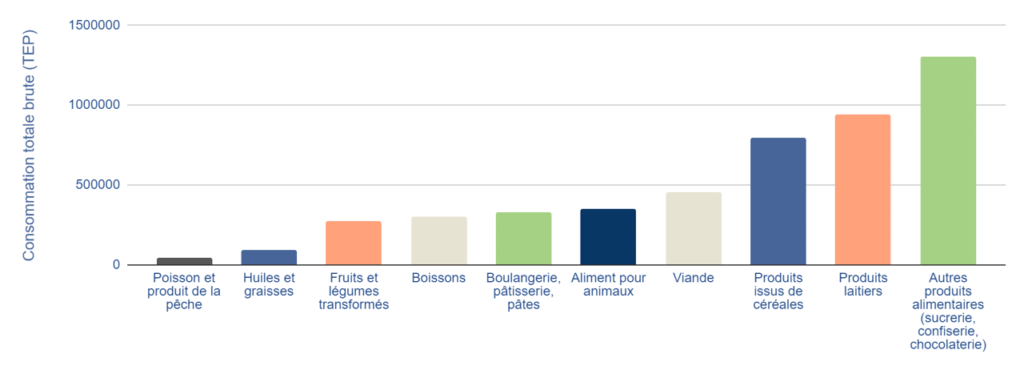
In France, the food industries with the highest total gross consumption (TOE ) (*) are those producing confectionery, dairy products & cereal products such as flour.
Still in France, the highest average TOE per plant is that of agri-food industries specializing in cereal products. This industry is followed at a distance by dairy producers. The average consumption of a single meat producer is among the lowest in the food industry.
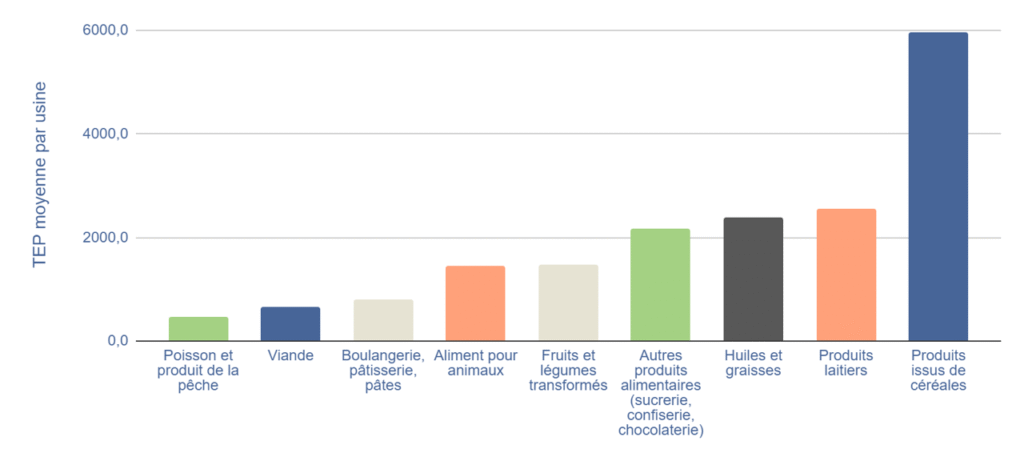
(*)These data come from Agreste, Chiffres & données N°2022-10, published in August 2022. For more information, click here.
Energy consumption hubs
Energy consumption and carbon footprint vary according to the products sold. Here are the poles that consume the most energy:
- Transformation processes Transformation processes: the industries that consume the most are the sugar and starch industries. These industries require significant transformation of raw materials. This involves a great deal of transport and long production chains, involving energy-intensive industrial equipment and processes.
- Transportation methods Transport accounts for 29% of CO2 emissions in France, and is an integral part of industry. Products transported by lorry, container ship or even, for certain fruits and vegetables, by plane, increase both your bill and your energy impact.
- Storage constraints Storage constraints: some products require special storage. Refrigerated lorries and warehouses, and humidity control are all measures that require additional energy.
- Production quantities Production quantities: logically, the more an industry produces, the more its machines are active, the more it stocks, and the more it needs to transport raw materials and deliver finished products.
There are many other energy consumption factors. The above are just a few examples where concrete action can be taken, thanks to the audit and advice of Dametis experts.
What are the levers for reducing energy consumption in the food industry?
1. Use of more energy-efficient equipment The use of more efficient, energy-saving equipment can help reduce energy costs and consumption.
2. Optimize existing processes Just a few automation adjustments can make all the difference.
3. Implement energy-saving measures Energy-saving measures, such as displaying lights on light switches or not leaving machines on standby, are just some of the small actions that, when taken together, represent significant savings.
4. Use of more efficient energy management(Energy Management) Energy Management Systems (EMS) can help companies monitor and reduce their energy consumption.
5. Use of information and communication technologies (ICT) ICT can be used to control and monitor energy consumption, and to implement energy efficiency plans.
6. Use of advanced technologies The use of advanced technologies can help reduce energy consumption.
7. Use of renewable energy sources The use of renewable energy sources such as solar and wind power can reduce energy consumption.
Dametis can help you find concrete ways to reduce your emissions and energy bills, while maintaining or improving your productivity. Whether you already have some ideas or would like a complete audit of your company, our experts will advise you from strategy development to implementation.