


The consultation is launched
On November 22, Agnès Pannier-Runacher, France’s Minister for Energy Transition, launched a public consultation on a document setting out the main directions of the country’s energy policy, as part of the work on the French Energy-Climate Strategy. The consultation was open until December 22, 2023.
The aim of the French Energy-Climate Strategy is to achieve carbon neutrality by 2050. It is based on four pillars: energy sobriety,energy efficiency, the revival of nuclear power and the acceleration of renewable energies.
This consultation is part of a process that will culminate over the coming months in a decree setting out the Pluriannual Energy Program (PPE), the main strategic document for steering France’s energy transition.
Be the first major industrial country to move away from fossil fuels
This is the commitment announced by the government. It meets three major challenges for France. The first concerns energy sovereignty. The war in Ukraine has shown that France is highly vulnerable to geopolitical events. Tensions are also appearing over the raw materials and equipment needed for the energy transition. Improving energy independence depends on abandoning imported fossil fuels, diversifying raw material supplies and developing an equipment industry for the energy transition.
109 billion euros
Fossil fuel import bill in 2022 vs. 48 billion euros in 2021
Source: SDES, Energy balance sheet
The second issue is economic. France’s balance of trade has been undermined by last year’s surge in energy prices. Fossil fuel import bills soared. Increased use of nuclear power and renewable energies should improve the country’s competitiveness.
The final challenge concerns the fight against climate change. The government wants to accelerate the decarbonization of all sectors: transport, industry, construction, agriculture and energy.
Being the first major industrial country to move away from fossil fuels implies profound changes, as illustrated by the graph below.
Final energy consumption 2021 and projections to 2050
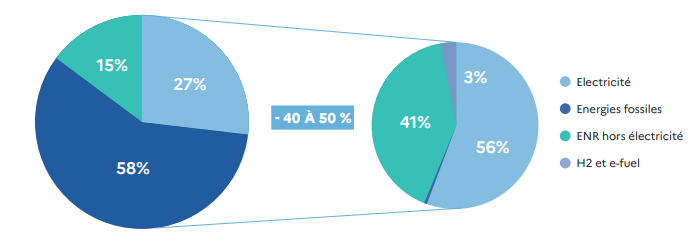
Energy consumption is expected to fall by up to 50% by 2050. The electrification of transport and heating systems in particular, thanks to improved efficiency, will go part of the way. Energy sobriety will have to do the rest, its contribution being estimated at between 15% and 20%.
51%
The share of fossil fuels in industry’s final energy consumption in 2021
Source: SDES, Bilan de l’énergie.
The move away from fossil fuels is a foregone conclusion. While they account for just under 60% of final energy consumption today (37% oil and 21% natural gas), we will have to do without them by 2050. While complete decarbonization of the electricity generation mix is already well underway, it has barely begun in the transport sector. Weaning ourselves off energy for heating buildings and industry is also a major challenge.
The last major challenge in changing the energy mix is to increase the production of decarbonized energy: nuclear power, renewable electricity, renewable heating and cooling, biogas, biofuels, etc. Electricity production should increase by 10% by 2030 and 55% by 2050.
This transformation to 2050 requires intermediate milestones to establish a trajectory. This is the purpose of the Multiannual Energy Programme, whose five objectives are presented in the document put out to consultation.
Objective 1: reduce energy consumption while reindustrializing the country
50 TWh
Additional final energy consumption linked to reindustrialization in 2030
Source: Ministry of Energy Transition
Final energy consumption has been falling for around a decade. The aim is to accelerate the pace of reduction. For 2030, the PPE sets an end-energy consumption target of 1,209 TWh for all energies and all sectors combined, representing a 25% reduction on 2021. This scenario incorporates a process of reindustrialization in France, which will increase energy consumption in the industrial sector, particularly for electricity. In parallel with reindustrialization efforts (“green industry” law, France 2030 program, etc.), the Multi-Year Energy Plan calls for an improvement in the industrial sector’s
Objective 2: adapt networks, in particular to industrial requirements
Increasing electrification, the development of renewable electricity production and the reindustrialization of our industry all require us to adapt our power grids. Investment requirements for the coming years are very high. RTE, the French electricity transmission system operator, is currently updating its investment trajectory. The previous assessment, carried out in 2019, put the investment required between now and 2035 at 33 billion euros. For its part, Enedis, the distribution network operator, is forecasting a 25% jump in its annual investments to reach 5 billion euros per year by 2032.
The Multi-Year Energy Plan calls for improved planning of connections in the most dynamic industrial zones and port areas. It also aims to strengthen the national industrial fabric for electrical materials and equipment linked to networks.
The issue of natural gas networks is very different. Natural gas consumption is set to decline irrevocably, in line with the goal of carbon neutrality by 2050. The challenge for gas network operators is to adapt their infrastructures to the drop in consumption, while integrating biomethane and hydrogen. The cost of adapting networks to green gas is estimated at between 6 and 9.7 billion euros between now and 2050.
Objective 3: guarantee security of supply
For fossil fuels and natural gas in particular, the challenges lie in diversifying supplies to reduce our exposure to geopolitical events, and in producing decarbonated substitutes (sustainable fuels, biomethane, etc.).
In the case of electricity, security of supply must be ensured not only by ramping up production, but also by developing flexibility to balance supply and demand during periods of peak consumption. Among the measures envisaged on the electricity supply side by the next multi-annual energy program are the development of interconnections, support for the deployment of batteries and the launch of calls for tenders for pumped-storage energy transfer stations (STEP). Demand-side measures are also planned. In particular, the government intends to introduce incentives or regulatory constraints for the control of certain equipment (charging stations and heating systems, for example). Electricity prices should also provide consumers with greater incentives to modulate their consumption during peak periods. Finally, new incentive mechanisms should be introduced to take full advantage of the potential of both diffuse and industrial load shedding.
Objective 4: preserve purchasing power and competitiveness
This objective is divided into two parts: one for households and the other for businesses. In the case of households, measures focus on support for energy renovation and assistance for the underprivileged. In terms of competitiveness, the next multi-year program aims to bring the electricity market reform project to a successful conclusion. Electricity prices paid by end consumers, particularly industrial consumers, must better reflect the production costs of nuclear power. This is the key issue at stake in the work currently being carried out in parallel with the next multi-annual energy program, concerning the system that will take over from ARENH from 2026 onwards. The government recently suggested an average nuclear electricity selling price of around €70/MWh, whereas the ARENH price is €42/MWh.
Finally, the5th objective is the development of decarbonized energy production, a major component of the next PPE. This will be the subject of our next article.