



Corporate decarbonisation
The environmental emergency is reshaping the rules of the economic world. Today, by actively pursuing a decarbonisation approach, companies are acting in favor of the environment while activating a real, long-term viable performance lever.

Decarbonisation: what are we talking about?
Decarbonation, also known as decarbonisation, encompasses all actions implemented to allow a company to reduce its greenhouse gas emissions. This term applies at different scales, from a country and its inhabitants to a company such as an industrial plant.
The importance of corporate decarbonisation: what are the real challenges?
To address the climate emergency and meet the expected objectives, corporate decarbonisation must accelerate. Clearly, the biggest polluters—namely companies—must act and implement action plans to reduce their carbon impact.
Government objectives for corporate decarbonisation
2030: reduce GHG emissions by 50% compared to 2030
2050: achieve carbon neutrality
The distribution of greenhouse gas emissions in 2024, calculated by the SDES and published by Citepa, shows the most polluting sectors of activity.
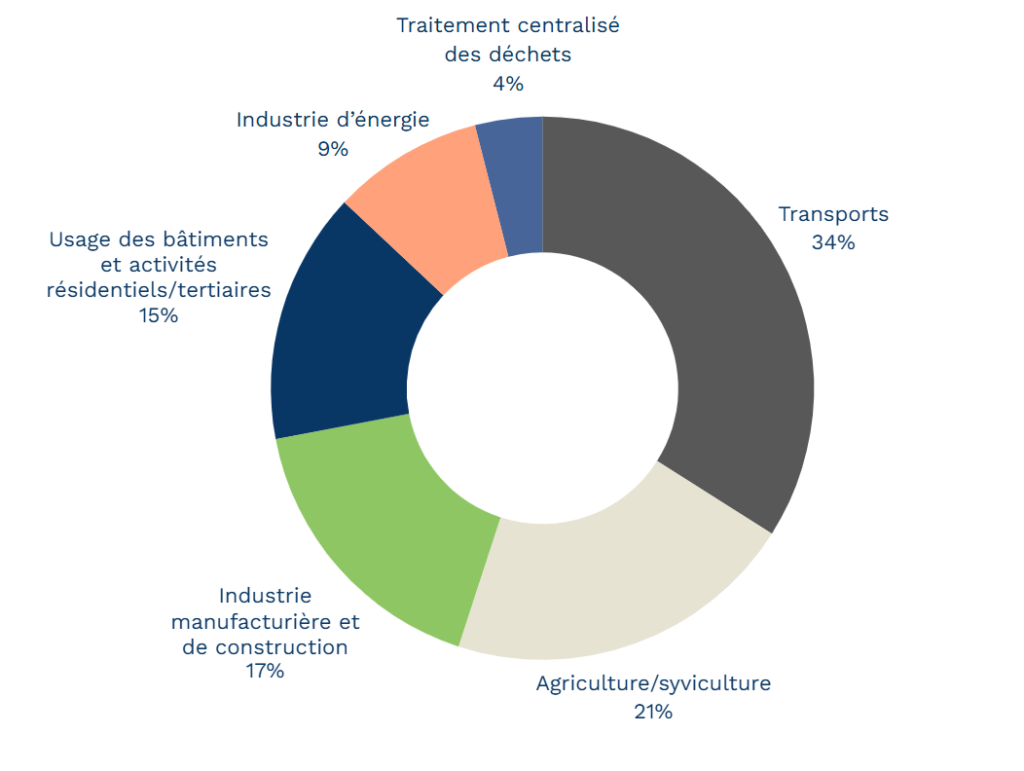
The decarbonisation of companies in this sector would address 2 major public challenges: environmental preservation and public health.
Environmental Preservation
During COP21, states committed to limiting global warming to between 1.5°C and 2°C by 2100 compared to the pre-industrial era. At first glance, such a variation may seem negligible, but it would nevertheless imply a multiplication and escalation of climatic phenomena.
Public Health
Corporate decarbonisation would also help improve air quality, which is currently highly polluted in some areas and responsible for many respiratory and cardiovascular diseases.
To support companies in their decarbonisation efforts, the French State relies on its roadmap, the National Low Carbon Strategy (SNBC), and on regulatory and financial mechanisms, such as the Green Industry Law and the France 2030 plan. While the Green Industry Law aims to reindustrialise France while developing green technologies, the France 2030 plan represents the investment plan intended to catch up with France’s industrial delay.
The SBTI framework also supports corporate decarbonisation: this global framework aims to help them set their greenhouse gas reduction targets to limit global warming to 1.5°C in accordance with the Paris Agreement.
Among the sectors called upon to accelerate their decarbonisation, industry is one where many levers still need to be activated to actively contribute to France’s objectives. Focus on this sector and the main actions to implement for the success of its transition.
Industrial Decarbonisation: What Action Plan to Implement?
Industrial decarbonisation largely relies on the implementation of energy optimisation actions and on the evolution of the energy mix. With or without investments, these actions must drastically reduce the factory’s carbon footprint.
As an industrialist, implementing an action plan will help you to structure your approach, prioritise tasks, and monitor the progress of your decarbonisation project. We share the steps to follow for optimal decarbonisation.
“You can only improve what you measure”
1. Conduct an assessment
An initial assessment must be carried out; our teams recommend performing a carbon footprint assessment or GHG assessment (BEGES).
While the carbon footprint assessment takes into account all company emissions, from scope 1 to scope 3, the BEGES only considers scopes 1 and 2, making it a more accessible assessment.
Another major difference between these two studies: their mandatory nature.
While the carbon footprint assessment is voluntary, the BEGES is a legal obligation for certain companies, which must renew it every 4 years.
2. Acquire an EMS (Energy Management Software)
The EMS software, an optional element that facilitates the identification and monitoring of optimisation actions to increase and sustain performance in the long term.
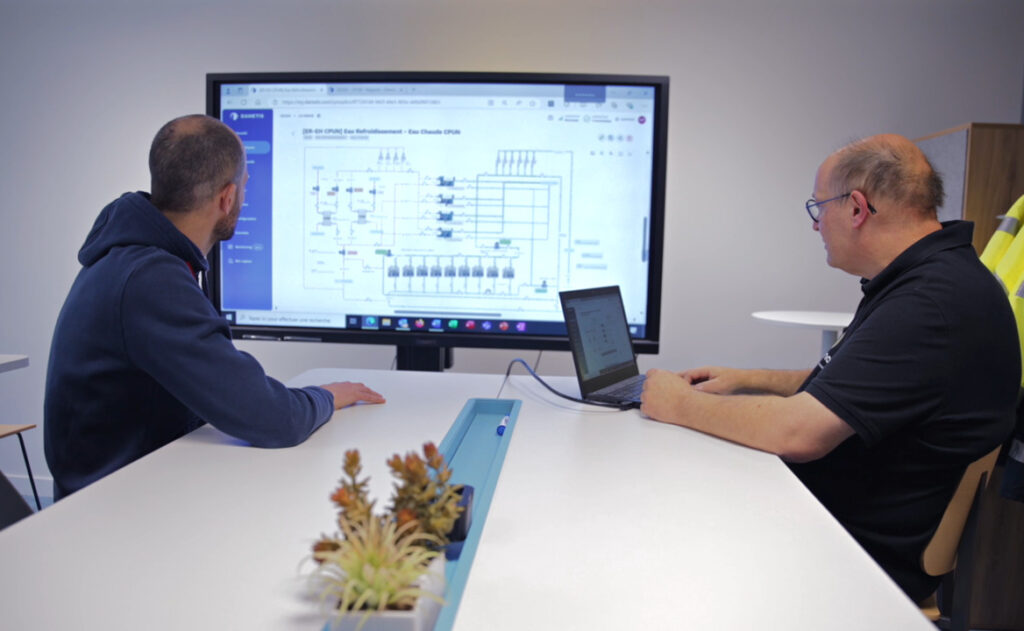
Connected to your factory’s sensors, this tool collects, verifies, sorts, and analyzes your data in real-time. You are thus alerted as soon as there is a leak or a deviation.
But these functionalities go far beyond simple monitoring. It helps you define objectives, manage your performance, and deploy a roadmap, at the site or group level, to optimise your energy and water management.
Monitoring software like MyDametis features a personalised interface (each role can highlight the relevant KPIs), making it possible to unite various teams in this project: management, production, maintenance, finance, etc. It is a true ally in implementing your corporate decarbonisation strategy.
3. Reduce your carbon footprint by activating simple levers without investment
In energy efficiency, daily actions are often underestimated.
Identifying simple actions, immediately achievable without particular investment, often drastically reduces energy consumption.
- Turn off an industrial oven between two production phases
- Start equipment a few minutes before use
- Adjust compressed air settings
These actions are simple, quickly actionable, and yet in industry, the opposite practices are often observed

4. Investing in corporate decarbonisation and evolving your energy mix
To go even further in your decarbonisation project, investments can be made. Beyond optimising your energy consumption, some of these actions also contribute to evolving your energy sources.
- The electrification of processes allows the substitution of fossil fuel combustion with electricity.
- The recovery of waste heat allows heating offices or reusing heat for other industrial purposes.
- The hybridisation of heat production. By combining two different heat sources (fossil energy – waste heat, for example), you gradually integrate greener sources.
- The optimisation of industrial cooling. For example, an industrialist saves an average of 50% of their cooling consumption by improving pump control.
- The integration of renewable energies to substitute your fossil fuels with more environmentally friendly energies. Various very different solutions are possible: biomass, methanisation, etc.
These projects are complex to implement, which is why at Dametis we created MyProject, a tailor-made offer for the turnkey execution of your projects and assistance with their financing.

Do you want to decarbonise your company?
Dametis supports you!
The benefits of corporate decarbonisation
By adopting a rigorous approach to decarbonise your activity, you benefit from new positive dynamics, both economic, social, and environmental.
Economic benefits
- The costs related to your energy consumption are reduced and better controlled
- Your resilience to energy price volatility increases
- Your investments to acquire innovative decarbonisation technologies are anticipated
Social benefits
- You improve the trust of consumers or (future) employees sensitive to environmental criteria towards your company
- You more easily meet the requirements of investors who now favour responsible companies
Environmental benefits
- You actively participate in environmental preservation
- You comply with environmental regulations while anticipating them and avoiding the risks of sanctions
- You improve your responsiveness to crisis situations
Do you want to implement an effective and sustainable decarbonisation strategy? Contact us!
Error: Contact form not found.