



Dametis supports you in decarbonising industry
Industrial decarbonisation: an obligation in the face of the climate emergency, but also an opportunity to reduce costs and increase competitiveness in a highly competitive market.
How to effectively and sustainably decarbonise your industry?
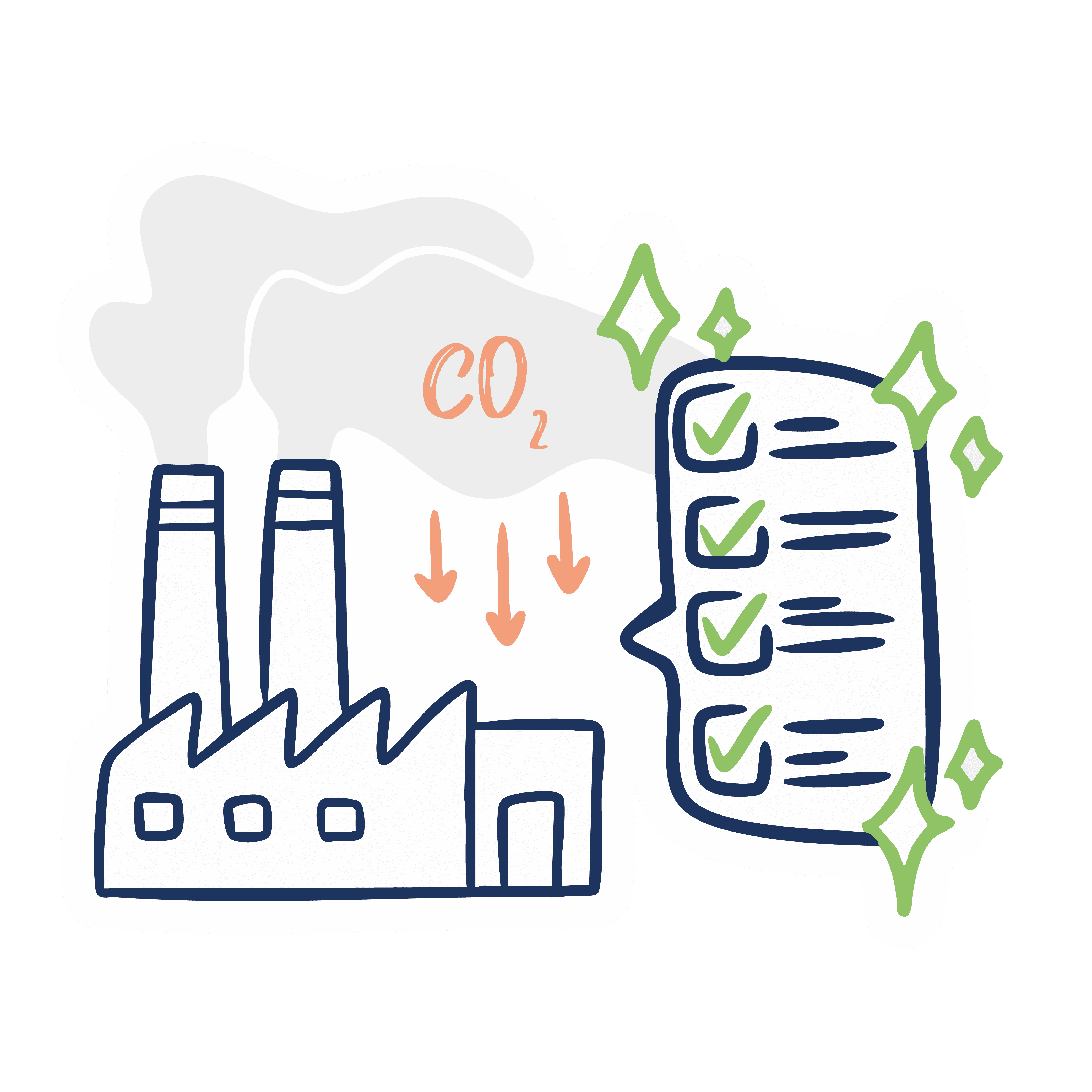
Industrial decarbonisation: what’s at stake?
Between 1990 and 2023, France reduced its carbon emissions (linked to CO₂) by 31%. This decrease is notably explained by deindustrialisation, but also by efforts made in terms of energy efficiency.
To achieve the goal of carbon neutrality by 2050, it is essential to accelerate this momentum. An intermediate milestone has been set for 2030: reduce greenhouse gas emissions by 50% compared with 1990.
In France, there are five main sources of greenhouse gas emissions. Among them, industry plays a major role, notably through emissions linked to industrial processes, which are a key lever for decarbonisation.
Industry therefore plays a central role in achieving GHG emission reduction targets, both in France and at the European level.
26%
Share of GHG emissions linked to energy, manufacturing and construction in France in 2023.
Source: Citepa
The France 2030 programme highlights the need to reindustrialise the country and accelerate its ecological transition. Industrial decarbonisation must contribute to this objective.
Industrial decarbonisation: a challenge with multiple benefits
Today, industrial decarbonisation largely relies on the evolution of the energy mix, i.e. replacing fossil fuels with low-carbon or even renewable energy sources. However, this transition is technically complex and first requires significant control and optimisation of consumption. Changing the energy mix may require significant investment from manufacturers: process electrification, waste heat recovery, etc.
However, financial aid for industrial decarbonisation exists and can reduce the return on investment time.
Dametis supports you in decarbonising your industry!
Indeed, the industrial market is now highly competitive, and while decarbonisation involves environmental, regulatory, economic and societal challenges, it is also important to remember that this objective can be a real asset for industry.
Beyond environmental commitment, industrial decarbonisation can bring other positive dynamics:
- Better control of costs by reducing energy consumption
- Increased resilience by being less dependent on energy price volatility
- Better responsiveness in crisis situations by defining predefined scenarios
- Improved brand image with customers and suppliers

Some industries have emissions that are harder to reduce than others—so how can you implement a decarbonisation strategy that is effective and sustainable over the long term?
How can you make your industrial decarbonisation a success?
In most cases, industrial decarbonisation relies on implementing energy optimisation actions and evolving the energy mix. These can be simple and quick to implement, or require more substantial investment. In all cases, their objective must be to reduce the factory’s carbon footprint while maintaining—or even improving—its production performance.
To ensure an efficient decarbonisation strategy, you first need to establish a baseline, i.e. identify energy flows and sources of CO₂ emissions.
To do so, it is recommended to carry out a carbon assessment or GHG assessment (BEGES).
GHG assessment or BEGES
This assessment covers scopes 1 & 2, i.e. direct and indirect emissions. The Environmental Code makes this baseline mandatory for all of the following organisations:
- Companies with more than 500 employees in mainland France
- Companies with more than 250 employees overseas
- State services
- Local authorities with more than 50,000 inhabitants
- Public institutions and other legal entities governed by public law with more than 250 staff (hospitals, for example)
The companies subject to this obligation must produce and publish a GHG assessment every 4 years. Public entities, on the other hand, are subject to more frequent update requirements, set at 3 years.
Carbon footprint
The carbon assessment, on the other hand, is not mandatory. The accounting scope is different: it takes into account all greenhouse gases emitted, and therefore covers scopes 1, 2 and 3.
It therefore includes all indirect emissions not included in scope 2. These are generally the most complex emissions to account for. They notably include all emissions linked to the logistics chain and product life cycle.
Would you like to carry out a GHG assessment?
Once one of these assessments has been completed, a strategy can be built.
Actions with or without investment? This depends notably on the factory’s maturity, the amount of GHG emissions produced per year, and the company’s decarbonisation goals.
Decarbonisation actions to quickly reduce your carbon footprint
In industry, several situations of this type are frequently observed: an oven kept running empty, a compressed air setpoint set too high, or equipment started up long before it is used.
These practices are often linked to a desire to ensure high production. Yet they generally bring no benefit and represent costs for the factory, both economically and environmentally.
These actions that seem harmless ultimately cost manufacturers a lot. Expert site visits can help identify them and address them quickly.
These optimisation actions, often quick to implement, help reduce the carbon footprint of an industrial site. However, to achieve a more ambitious industrial decarbonisation target, it is sometimes necessary to go further and commit financial investment.
Possible investments for optimal industrial decarbonisation
Depending on the site’s processes and utilities, different actions are possible. These are mostly fairly technical energy projects, but well within reach when working with experts.
Equipment modernisation
Over time, equipment wears out and is no longer able to combine high productivity with a low carbon impact. It can therefore be relevant to replace existing equipment with newer technologies designed to minimise energy consumption while delivering better performance.

Here, the combustion of fossil fuels is replaced by decarbonised electricity across various processes requiring hot water and/or steam. For example, ovens can be electrified.
This involves capturing the heat rejected by a process and reusing it for industrial purposes in another process.
180 tonnes of CO2
amount of GHG emissions avoided each year at Croda thanks to waste heat recovery.
Hybridisation of heat production
This system combines at least two different energy sources, typically fossil energy and energy from waste heat recovery. This makes it possible to be less dependent on fossil fuels and integrate greener sources, without drastically modifying all resources.
Optimisation of industrial cooling
The refrigeration cycle can be optimised, notably with self-adaptive electronic expansion valves, or by regulating distribution pumps, for example. By improving pump control according to needs, an average of 50% of their consumption is saved.
With MyProject, our experts support you in the decarbonisation of your industry through turnkey technical projects!
Different types of support are available to finance this kind of project. They enable a very fast return on investment. Find out more.
Track the evolution of your carbon footprint over time

To implement an effective industrial decarbonisation strategy, you need to know the starting point precisely, with a global view of the site’s consumption and emissions. However, this approach is also essential to assess the impact of optimisation actions.
Without clear visibility on energy consumption data and the associated carbon footprint, it is difficult to identify and prioritise the most relevant actions to reduce costs and environmental impact. There is then a risk that manufacturers focus their efforts on low-emitting areas, thereby limiting the impact and effectiveness of their low-carbon strategy.
To address this, our teams recommend implementing an EMS software (Energy Management Software).
Once implemented within the factory, the tool makes it possible to monitor consumption in real time, visualise changes in the site’s carbon footprint and assess the impact of the actions taken. Continuously fed by site data—which it validates and contextualises—the EMS facilitates decision-making by identifying deviations and recommending various improvement actions.
Usable by very different roles within the industrial group (Management, Production, Finance, Maintenance, etc.), the software helps simplify both the building and monitoring of an industrial decarbonisation strategy. It is a true pillar for continuous performance improvement within the factory.
Dametis supports you in decarbonising your industry
Error: Contact form not found.