


Industry 4.0: definition of this revolutionary concept
Industry 4.0: definition of this concept born in the 2000s and a closer look at its impact in factories.
Industry 4.0: definition
Industry 4.0, in other words the fourth industrial revolution, is also known as “Industry of the Future” or “Smart Factory”.
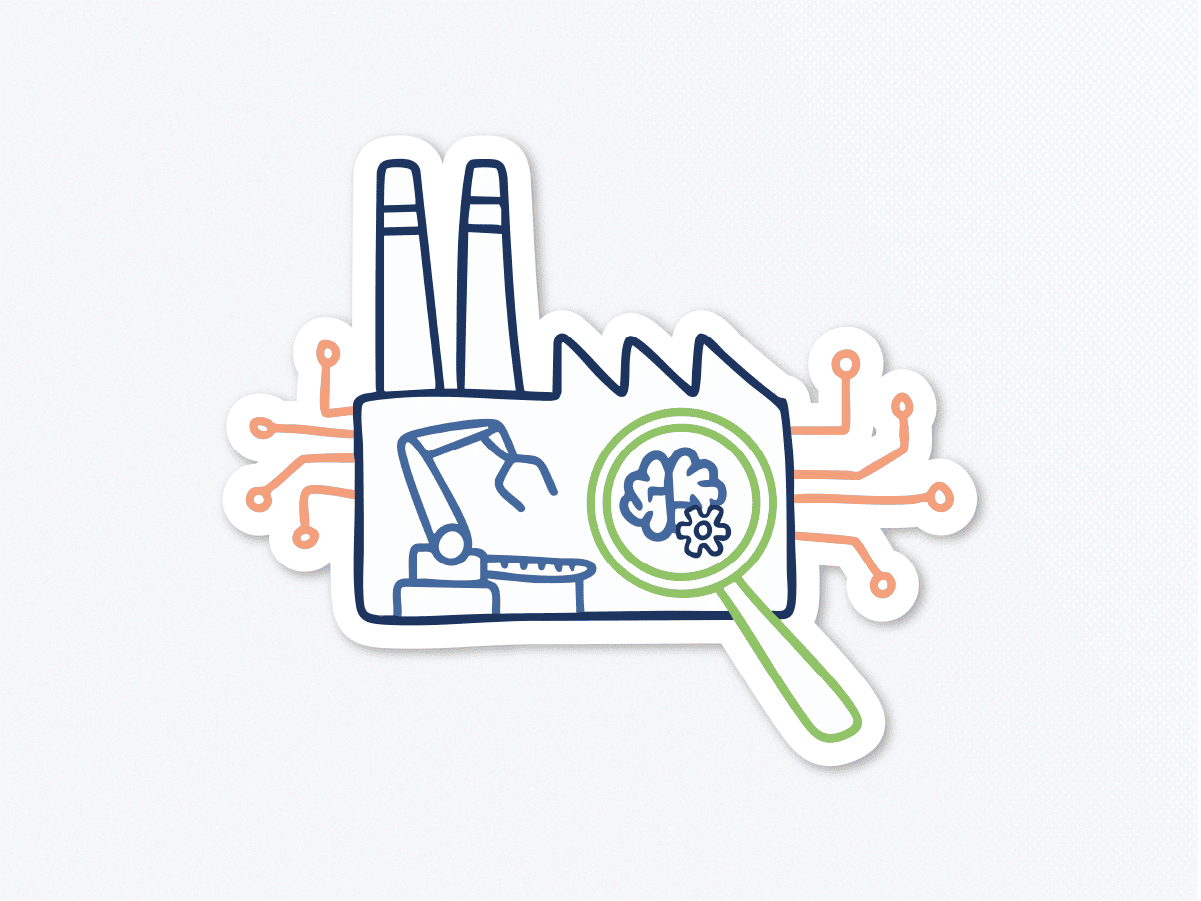
Overall, Industry 4.0 is defined as an evolution of factories and their production systems, due to the integration of intelligent digital systems into processes.
The interconnectivity offered by the Industry 4.0 concept aims to enable factories to optimize their production and employees’ work, while ensuring their environmental impact. Today, the most important and profitable element of the concept for manufacturers remains operational performance.
Do you want to take action for the decarbonization of your industry?
Industry 4.0: how did we get here?
Over the years, new technologies have emerged. They have disrupted our daily lives, but also those of factories, which, to remain competitive, had no choice but to adapt. In industry, we talk about four main revolutions.
- During the first industrial revolution, mechanization emerged
- During the second industrial revolution, energy sources evolved and assembly-line work spread. During this period, factories wanted to produce more quickly, at scale, and at low cost.
- The third industrial revolution saw the emergence of IT. Thanks to fixed programs, production—and more specifically repetitive and complex tasks—became automated.
- Then came the fourth industrial revolution, marked by more powerful technologies that are more deeply integrated into factories. Machines are no longer given a fixed program; they are connected to each other, to the outside world, and to factory data to optimize production. It was in this context that the concept of Industry 4.0 was born.
How does Industry 4.0 work?
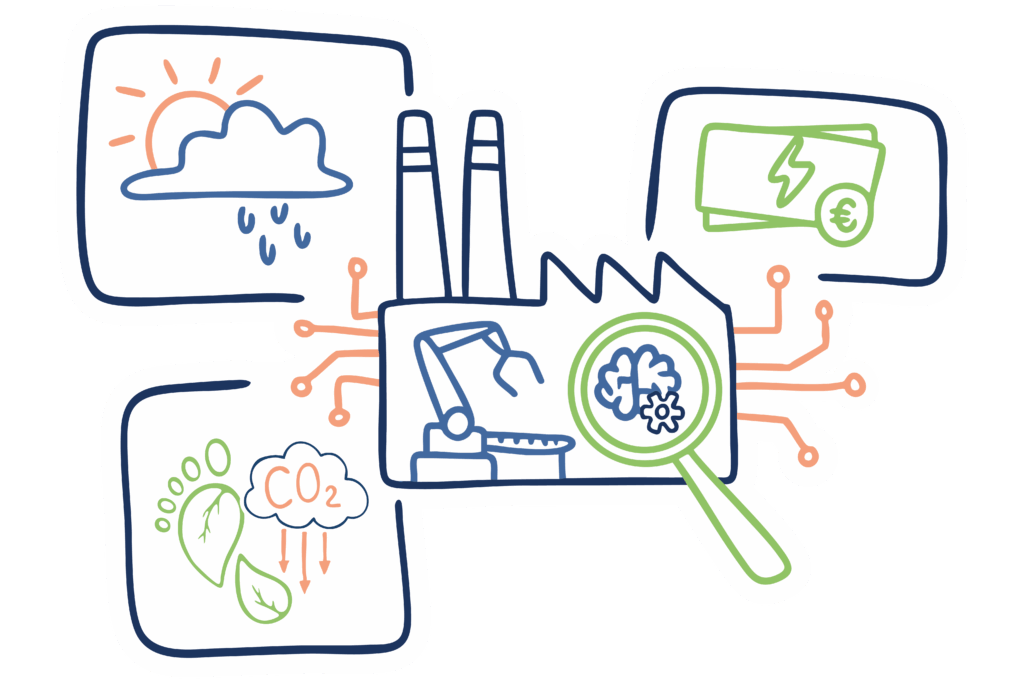
Data is the central element of the Industry 4.0 concept.
Collected by IoT (Internet of Things) and industrial sensors, data is then centralized in the Cloud, where it can be used in different ways.
As industrial data evolves rapidly and is available in very large quantities, artificial intelligence is essential to use it effectively. Made up of algorithms created by human experts in their field (such as energy, for example), this AI checks, sorts, analyzes, and contextualizes the data.
In practical terms, the Industry 4.0 concept and the AI it brings have been rapidly deployed in factories by transforming production equipment and the management of consumption and performance.
Did you know?
Providing a wide range of real-time field data (temperature, pressure, flow rate, mass, etc.), industrial sensors, placed within processes and utilities, must be checked regularly.
They are essential to ensure reliable analyses and decision-making, enabling the factory to achieve its objectives.
Dametis supports you with sensor checks!
AI in production equipment
To increase production while making it more reliable and safer for people, the Industry 4.0 concept has transformed many pieces of equipment. For example:
- Production machines now integrate cobots (collaborative robots). Designed to interact physically with the operator safely, they adapt to variations in the production line.
- Machine vision systems, capable of detecting a production defect invisible to the naked eye.
- Internal logistics flows, automated by AGVs (automated guided vehicles) or AMRs (autonomous mobile robots), capable of recalculating their routes according to workshop contingencies.
AI in managing industrial performance
Data centralized in the cloud communicates directly with software such as an MES, a PLM, a CMMS, an EMS software (Energy Management Software).
A true foundation of Industry 4.0, EMS software connects and centralizes all its technology building blocks to provide an actionable view of the processed data. It thus provides a clear view of the modeled factory and data translated into reports, charts, dashboards, etc.
Industry 4.0 has therefore been synonymous with a new boom for factories. Their day-to-day operations have been profoundly transformed by the emergence of new technologies, making it possible to strengthen analysis and production activities beyond traditional production.
The impacts of Industry 4.0 on factories
This industrial revolution and the arrival of Industry 4.0 have brought about many changes. Like any transformation of this scale, it came with points of vigilance, notably on these two topics: securing information and the evolution of skills and roles within teams.
implement an Energy Management System!
Cybersecurity, a key challenge of Industry 4.0
Historically, the world of IT (management information systems) and OT (operational control systems) worked very differently. Factory networks benefited from strict segmentation, keeping them safe from cyberattacks. With the advancement of new technologies, these two worlds became connected to enable real-time data collection and analysis, exposing OT to cyber risks. To address this vulnerability, fortunately solutions exist (encrypted connection, protected internal cloud, anonymized data, …) and are fully compatible with (and integrated) with software such as EMS or EMOS.
The evolution of roles to keep pace with a radical change in how the factory operates
As repetitive and complex tasks have been replaced by generally collaborative robots and factories’ needs have evolved, roles have followed this trend.
New profiles have emerged, notably to manage and leverage these new technologies: data analyst, maintenance technician for the predictive side, Energy Manager, etc.
A large majority of factories have been able to meet these challenges brilliantly, by working with specialized service providers or by taking the necessary time to carry out these initiatives properly. And for good reason: the positive impacts of Industry 4.0 are significant, and in particular help to remain competitive.
The biggest benefits of Industry 4.0
Team autonomy increases. Thanks to automated data analysis and recommendations for actions aimed at optimizing factory performance, teams can make decisions more easily and quickly.
Production increases. Installations are optimized to work together, according to well-defined and optimized recipes and a manufacturing schedule. Production lines are therefore stopped for less time.
Costs are reduced. Installations are set up to limit energy overconsumption and equipment wear. These adjustments help improve and refine the use of resources and raw materials. In addition, software tools make it possible to quickly detect deviations, identify their causes, and recommend appropriate corrective actions. All of these actions have a direct impact on costs, which then decrease drastically.
The factory’s environmental impact decreases. A smart factory is a factory that combines high productivity and sobriety. The more processes are optimized, the more GHG emissions and environmental discharges decrease.
From identifying performance levers to deploying solutions tailored to your challenges, Dametis supports you with the Industry 4.0 concept!
Beyond Industry 4.0, Industry 5.0 offers a new perspective: that of an industry that is more sustainable, resilient, and human-centered. Technologies strengthen collaboration between teams to more easily achieve the factory’s objectives—those that address social and environmental challenges while combining high productivity.
Talk to an expert
Error: Contact form not found.