


We designed Smart Control, a self-adaptive solution built to keep industrial equipment running at peak performance, continuously. Thanks to its intelligent algorithms, Smart Control is particularly well suited to the needs of industrial players with high utility consumption. The result: up to 30% energy savings on refrigeration systems and between 15 and 20% on compressed air systems!
We spoke with Sébastien Papouin, Technical Director at Dametis, to fully understand how this solution works and the concrete benefits it delivers!
A solution for industrial players with high utility consumption
Dametis is renowned for its expertise in visualizing and optimizing industrial facilities. How does the Smart Control solution build on this expertise?

Sébastien Papouin: Smart Control is connected to our flagship solution, our EMS software (Energy Management Software) MyDametis. That’s the starting point: it collects data from an industrial site, centralizes it, and carries out a complete analysis. Based on this intelligence, MyDametis identifies the optimal settings and operating points for the facility.
The Smart Control solution comes into play at the next stage. It continuously controls the facility to help it reach its optimal performance. In other words, Smart Control implements the EMS’s recommendations to ensure the best possible efficiency of the equipment.
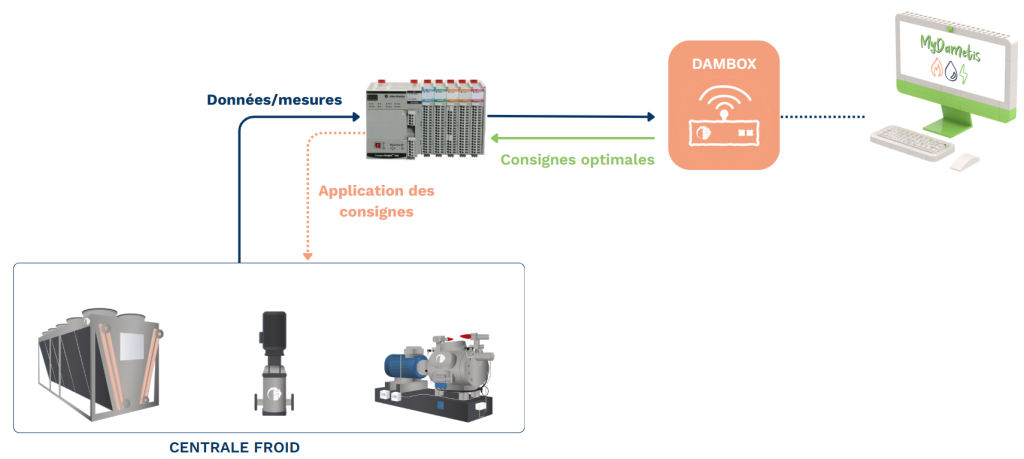
Figure 1 – How Smart Control works
Beyond this complementarity with the EMS, on what types of facilities or in what industrial contexts does Smart Control reveal its full potential?
Sébastien Papouin: Smart Control is very well suited to industries that use utilities with a direct impact on plant profitability. This is particularly the case for refrigeration systems, compressed air systems, and air handling units.
The stakes vary greatly depending on the sector! In certain industries, such as the food and beverage sector, for instance, the energy consumption of utilities can account for up to 70% of the plant’s total. This is where the Smart Control solution really makes sense!
Right now, for example, we’re supporting a food and beverage company on a refrigeration productionfacility that incorporates waste heat recovery from condensation for defrosting and domestic hot water production.
The energy consumption of utilities can account for up to 70% of the plant’s total.
Optimal equipment performance through real-time setpoints
Once deployed on this type of facility, how does the Smart Control solution work in practice to optimize performance in real time?
Sébastien Papouin: Smart Control is a unit connected to the controller that incorporates our algorithms. It continuously uses the equipment’s operating data, supplemented if needed by manufacturers’ databases and additional forecast data.
Based on this information, the system builds an initial model by calculating the facility’s theoretical optimal operating conditions. It then determines the best setpoints to apply.
A learning phase then begins: Smart Control tests its recommendations, analyzes the facility’s actual response, and automatically adjusts its parameters if the observed results differ from the expected performance. The solution then sends these setpoints to the controller, which remains the true pilot of the system, in order to bring the facility to its optimal level of efficiency.
“Smart Control determines in real time the optimal performance level the facility can reach based on operating conditions, and sends it the setpoint needed to get there”
Smart Control’s main strength therefore lies in its ability to continuously adjust equipment control setpoints based on actual operating conditions.
Sébastien Papouin: Absolutely! Instead of operating with fixed setpoints defined once and for all, the controller runs the facility using smart, optimized setpoints. These are automatically adjusted based on various parameters: changes in the plant’s needs, weather conditions, or even economic data such as energy prices or peak/off-peak rates, for example. By cross-referencing all this data, the system can calculate optimal operating setpoints.
Let’s take a concrete example. Whether controlled with or without Smart Control, a refrigeration unit must always deliver the same level of cooling, for instance maintaining a temperature of -5°C. The difference lies in the optimization of the control process: Smart Control automatically adjusts the refrigeration unit’s various setpoints to improve its energy efficiency, while guaranteeing the same quantity and quality of cooling produced.
3 concrete benefits for industrial players
What concrete benefits does this continuous, self-adaptive optimization bring to industrial players?
Sébastien Papouin: I’d highlight 3 main ones. First, Smart Control makes it possible to achieve significant water and energy savings: up to 30% energy savings on refrigeration systems and between 15 and 20% on compressed air systems!
In addition, Smart Control reports on equipment wear and tear, which other conventional controllers would not be able to do. The system is therefore able to detect performance drift and issues on each facility. It operates within a defined performance framework and can automatically detect any anomaly or degradation when a piece of equipment moves outside its normal operating range.
We deployed Smart Control on a refrigeration facility made up of several pieces of equipment. At one point, the system detected a performance drift on one of the three condensers. Thanks to the facility’s overall control, an alert was immediately sent to the customer, allowing them to quickly identify the source of the malfunction. Once the equipment was repaired, Smart Control automatically recalculated the optimal setpoints and the facility returned to its usual performance level, in a fully self-adaptive way.
The optimal operation of equipment, ensured by Smart Control, also helps reduce maintenance needs. Indeed, equipment operated under optimal conditions experiences less wear over time, which helps extend its service life.
Finally, the last benefit, and not the least: Smart Control delivers energy savings while significantly limiting CAPEX (capital expenditure), since it doesn’t require replacing equipment but works with what’s already in place.
And all this without affecting the way production is carried out?
Sébastien Papouin: Absolutely! Smart Control maintains exactly the same level of production and quality as before. In other words, the solution doesn’t act on the industrial need itself, but on how the facility meets it. In all cases, it’s essential to point out that the company retains full control of its system: the customer can activate or deactivate Smart Control at any time. If the solution is stopped, the facility immediately returns to its original operating mode.
Finally, are you considering expanding the scope of Smart Control in the future?
Sébastien Papouin: Yes, while the solution is mainly dedicated to utilities today, it’s designed to extend to industrial processes in the future!
I’m contacting Dametis to reduce my energy consumption with Smart Control
Error: Contact form not found.