



What is the tertiary decree?
For a number of years now, France has been making a point of limiting global warming, and this includes accelerating the energy transition of businesses. Coming into force in 2019 as part of the ELAN law, the Tertiary Decree is also known as the Tertiary Eco-Energy Device (DEET).
As a reminder, the Elan law (Evolution du Logement, de l’Aménagement, et du Numérique) enacted in 2018, aims to meet the many housing demands, simplify housing-related standards and promote social housing.
The tertiary sector decree is a regulatory text that implements Article 175 of this law. It focuses on the energy performance of buildings, and specifies that the tertiary sector must reduce its energy consumption. In this context, the tertiary sector decree requires tertiary buildings to significantly reduce their energy consumption by 2050.
Which infrastructures are covered by the tertiary decree?
All owners or tenants of buildings, parts of buildings or groups of buildings housing a tertiary activity with a surface area equal to or greater than 1000m² are affected by the tertiary decree. Thus, if a building is mixed-use, only the part housing a tertiary activity is affected. In the case of a group of buildings located on the same site or land unit*, it is necessary to cumulate the surface areas on which a tertiary activity is carried out to determine whether or not the building is subject to the tertiary decree.
Under the tertiary sector decree, owners will have to take action on the building and on their activity if they carry it out themselves. Tenants, on the other hand, will be able to act solely on their activity.
The decree covers a wide range of buildings in both the private and public sectors. The buildings concerned are as follows:
- The offices
- The hotels
- The shops
- Teaching buildings
- Administrative buildings
- Logistics
- Health
- Sports
This means that manufacturers may find themselves affected by the tertiary decree if they own :
- A company restaurant
- Administrative offices or office space (HR, Sales, etc.)
- A showroom
- Storage space
Special features of storage space in tertiary decree
Among storage spaces, the following are not subject to tax:
- The raw material storage area, or silo, for unfinished bulk products included in the industrial process
- Storage space for finished products, prior to shipment only and on a just-in-time basis, with a maximum stay of 5 days.
Storage spaces subject to compliance with the tertiary sector decree :
- Storage space for finished products where the manufacturer does not operate on a just-in-time basis and where finished products are stored for more than 5 days.
*a single plot made up of one or more parcels belonging to the same owner or to the same division.
What are the requirements?
To achieve the objective of improving sustainable development within the French territory, the Government, in the context of the tertiary sector decree, has imposed on companies a reduction in their energy consumption by 2050. In order to achieve this objective within the next fifteen years, the government has set various targets, expressed in absolute or relative terms. The choice of how to meet the objectives of the tertiary sector decree is entirely up to the client. In the event of non-compliance, the tertiary decree stipulates that sanctions may be applied.
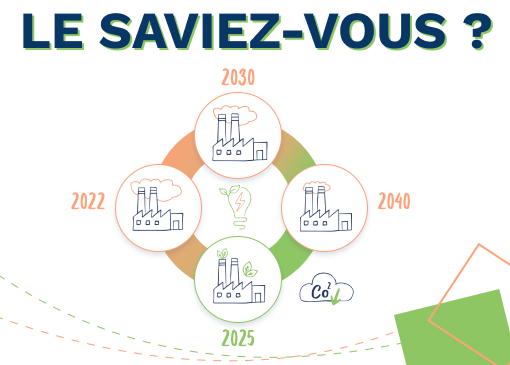
In order to reach the target using the relative value method, the French government has set up a series of “stages”, which will take place every decade until the final target is reached in 2050. The stages set by the tertiary sector decree, which must be respected by the owners or tenants of a building housing a tertiary sector activity, are as follows:
- Reduce final energy consumption in buildings by 40% by 2030
- Reduce final energy consumption in buildings by 50% by 2040
- Reduce final energy consumption in buildings by 60% by 2050
This energy reduction must be compared with a reference year chosen between 2010 and 2019, provided by the taxpayer himself.
Choosing this relative value method can be beneficial in the case of a tertiary activity carried out in an older, more energy-intensive building.
In the case of the absolute value method, the targets to be reached will be set according to building category, geographical zone and altitude. In relation to these elements, the thresholds will differ from those of the relative value method, as they will depend on two components:
- HVAC = Heating, air conditioning, ventilation
- USE = Specific use
This method of absolute value, within the framework of the tertiary sector decree, is to be favored when the taxpayer owns a recent building with low energy consumption.
In the event of a change in the building’s tertiary activity, the part or whole of the building linked to the tertiary activity will remain subject to the tertiary decree, although the targets will be readjusted to reflect the new type of activity.
In certain cases, these levels can be modulated, notably in the case of technical constraints, when the situation does not allow such high targets to be reached: building too old, new activity, etc. In this situation, it is necessary to draw up a technical file, which must then be sent to the OPERAT platform. In such cases, a technical file must be drawn up and sent to the OPERAT platform.
How do I enter data relating to the tertiary sector decree?
An OPERAT computer platform, managed by ADEME, has been set up. It enables taxpayers to enter the information required by the government, such as :
- Description of tertiary activity
- Floor area of buildings used for this activity
- The reference year, mandatory regardless of the method chosen ( the reference year should have been entered in September 2022).
- Annual building energy consumption data
- Possible adjustments to targets
From now on, and from 2022 onwards, taxable persons must transmit their building’s final energy consumption for the previous year to the OPERAT platform by September 30 each year.
As the tertiary sector decree is a vast and complex subject, the OPERAT platform also features a FAQ tab to answer any more in-depth questions.
How to meet the requirements of the
tertiary sector decree?
To avoid any penalties, those subject to the law must proceed methodologically. Here are the steps to follow in order to reduce energy consumption:
Step 1: Identify premises subject to the tertiary sector decree
Step 2: Analyze your buildings’ biggest energy guzzlers
Step 3: Set up an action plan to reduce your consumption and meet the targets set by the tertiary sector decree
To meet the requirements of the tertiary sector decree, you can call on external service providers to help you reduce your energy consumption and fill in the data on the OPERAT platform.
What are the penalties for non-compliance?
Under the tertiary decree, taxable persons are required to :
- Declare your data each year before September 30 on the OPERAT platform
- Meeting the targets set by the tertiary sector decree
Failure to comply with either of these obligations can result in various penalties.
In the event of unjustified non-declaration of data on the OPERAT platform :
The prefect responsible for the building and tertiary activity concerned may issue a formal notice to the taxable person, giving him three months to fill in the missing information.
In the event of non-compliance with the objectives set by the tertiary decree :
The prefect can issue a formal notice to the person concerned, who will have six months to submit an action plan to which he or she is committed. If, at the end of the 6-month period, no progress has been made, the prefect can issue an individual formal notice to the owner or lessee. The latter will then have three months in which to submit their action plan, which must comply with their respective obligations.
Following the last formal notice, and if the subject has not communicated its action program to the Prefect, the Prefect may impose a financial penalty of up to €1,500 for an individual and up to €7,500 for a legal entity.
It’s worth noting that in France, a document published online lists formal notices that have remained without effect. In this way, formal notices can have a serious impact on a company’s image and reputation, and consequently on its business.