


GHG balance or carbon balance?
Do you want to reduce your GHG emissions? Understanding the difference between these two balances is important!
Current regulations require certain companies, local authorities and government agencies to measure their impact on the climate. Other organizations are voluntarily taking similar steps. But in this field, technical terms are numerous and sometimes confusing.
Among them, two concepts are often mentioned: the greenhouse gas emissions balance (GHG balance) and the Bilan Carbone®. Although they are sometimes used synonymously, these two tools do not have exactly the same role or scope. And yet, understanding their differences is essential if you are to fully commit to a
Would you like to improve your industry’senergy efficiency?
A single approach to accounting for all greenhouse gas emissions
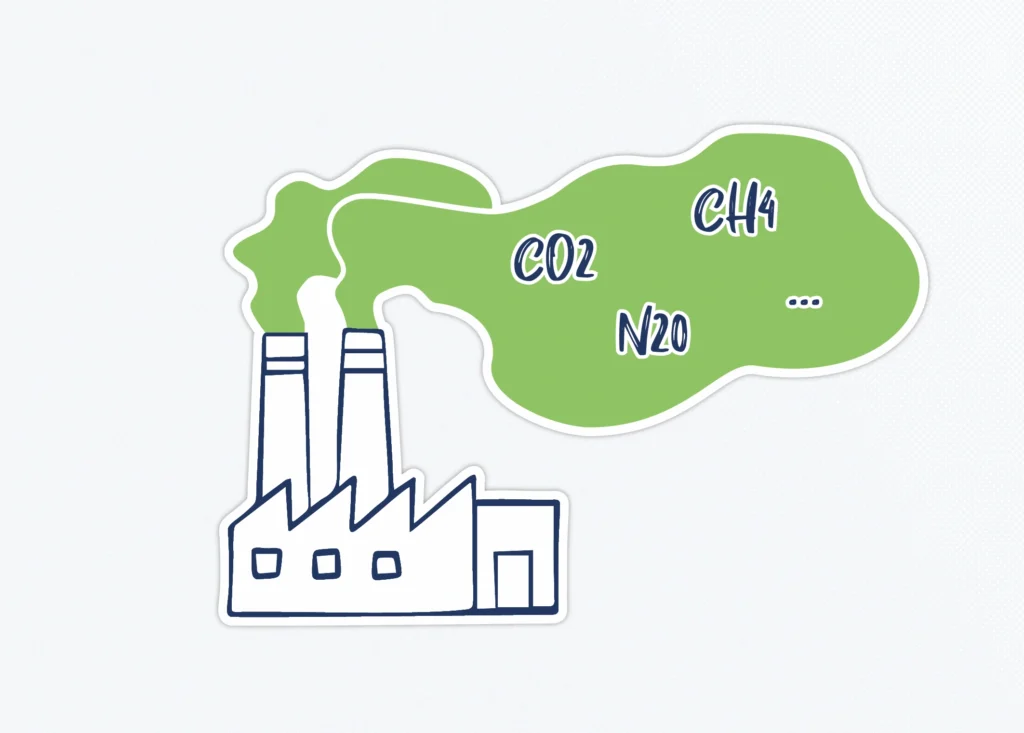
Whatever their names, the various “balances” involve measuring emissions of all greenhouse gases (GHGs): carbon dioxide (CO₂), methane (CH₄), nitrous oxide (N₂O), fluorinated gases (HFCs, PFCs, HFEs, etc.), sulfur hexafluoride (SF₆) and nitrogen trifluoride (NF₃).
However, these different greenhouse gases are not equally harmful to the climate, or more precisely, they do not have the same global warming potential (known as GWP). For example, one tonne of methane emitted into the atmosphere is equivalent to the emission of 28 tonnes of CO2. Methane thus has a GWP of 28. For fluorinated gases, the GWP exceeds 10,000. For this reason, measured GHG emissions are expressed in tonnes of CO2 equivalent (or t eq CO2).
The accounting approach and the number of greenhouse gases taken into account are therefore similar whatever the methods used. On the other hand, there are some marked differences, notably in the scope of accounting.
In addition, both GHG and carbon footprint® assessments are consistent with ISO 14 064.
Bilan GES: a legal obligation for the players concerned
Bilan des émissions de gaz à effet de serre, bilan GES or even BEGES refer to the same concept: it’s the official term used in French regulations.
The GHG balance sheet is a legal obligation initially introduced by the Grenelle law in 2010. This obligation applies to :
- Companies with over 500 employees (250 in overseas territories).
- Local authorities (State, regions, départements, metropolises, urban communities, conurbation communities and communes or communities of communes with more than 50,000 inhabitants).
- Public establishments and other legal entities under public law with more than 250 employees (hospitals, etc.).
The regulations require us to take into account :
- Scope 1, i.e. direct emissions produced by the organization’s activities (on-site combustion, industrial processes, etc.).
- Scope 2: indirect emissions linked to the consumption of purchased energy (electricity, heat, steam, etc.).
Would you like to improve your industry’s GHG footprint?
On the other hand, the inclusion of Scope 3 emissions (which cover other indirect emissions linked, for example, to purchasing, employee commuting, etc.) is only recommended, not mandatory.

Companies must update their GHG balance sheet every 4 years (3 years for local authorities and public establishments). It’s a little-known fact that
Ultimately, the GHG balance sheet is above all a regulatory tool. It enables us to account for an organization’s emissions and identify avenues for reduction. A transition plan including objectives, resources and planned actions must be attached to the report.
Bilan Carbone®: a voluntary approach with a broader scope
Unlike the GHG balance, Bilan Carbone® is a registered trademark. It was developed by ADEME in 2004.
It is now supported by the Association pour la Transition Bas Carbone (formerly known as Association Bilan Carbone®). Founded in 2011, ABC is a public interest association dedicated to disseminating the Bilan Carbone® methodology. It provides organizations and individuals with the tools and methods they need to successfully define and implement their
The Bilan Carbone® is a calculation methodology used to account for all GHG emissions. It differs from the GHG balance sheet in two main respects:
- Bilan Carbone® is based on a voluntary approach (as opposed to a regulatory obligation for those involved in GHG assessments).
- Scope covered. The Bilan Carbone® covers all emissions: direct emissions from scope 1, indirect emissions from scope 2 and indirect emissions from scope 3 (not included in the GHG balance).

20 000
The number of people trained in the Bilan Carbone® approach
Source: ABC
The latest version of the Bilan Carbone® tool is now available in the form of a software package (rather than Excel spreadsheets) called Bilan Carbone® + (or BC+).
The Bilan Carbone® aims to identify the main emission sources in order to build a strategic action plan in line with the French National Low-Carbon Strategy (SNBC) .
Bilan GES and Bilan Carbone® towards a gradual convergence … ?
Regulations governing the measurement of greenhouse gas emissions are evolving and becoming progressively stricter.
For example, the Corporate Sustainability Reporting Directive (CSRD), applicable from January 1, 2024, sets out new annual obligations for the publication of sustainability information. This includes an emissions report, including scope 3. The first reporting deadline is 2026 (with 2025 data) for companies with more than 250 employees and sales of over €50 million, with a balance sheet total of over €25 million. From 2027 (2026 data), all listed SMEs will also have to comply. They will, however, be able to benefit from a two-year grace period for their first publication.
In the long term, it is possible that the regulatory obligation for all players will cover scope 3, bringing us closer to the current scope of analysis of the Bilan Carbone®.